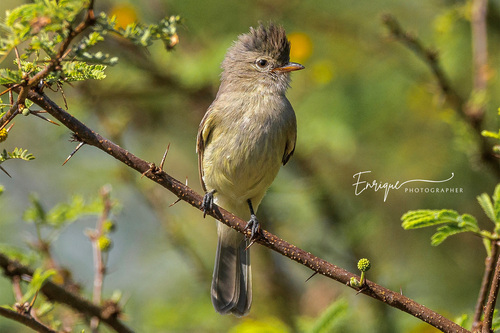
Northern Beardless-Tyrannulet
Camptostoma imberbe
Meet the tiny, energetic master of the thicket. Though small and subtly colored, the Northern Beardless-Tyrannulet is a powerhouse of activity, known for its peaked crest and distinctive whistling song.
Quick Identification
Size
Length: 4–4.5 in (10.2–11.4 cm); Wingspan: 6.5–7 in (16.5–18 cm); Weight: 0.2–0.3 oz (7–9 g)
Colors
Dull grayish-olive upperparts, pale yellowish to white underparts, two faint white wing bars, and a dusky crown. Sexes are similar in appearance.
Key Features
- Small, thin bill with few visible bristles
- Bushy, often raised crest giving a peaked-head look
- Frequent tail-twitching and wing-flicking behavior
- Plain face with a subtle, pale eye-ring
When You’ll See Them
Behavior
Despite its name, this tiny flycatcher is far from boring. It moves with a restless energy, constantly flitting through the dense canopy or scrubby undergrowth. Unlike many flycatchers that 'sally' out to catch insects in mid-air, the Northern Beardless-Tyrannulet is primarily a gleaner, picking larvae and small insects directly from the undersides of leaves and twigs with surgical precision.
It is a solitary bird for most of the year, though it may occasionally join mixed-species foraging flocks during the winter months. Its presence is often announced by its voice rather than its appearance—a series of thin, whistled 'pee-yee-yee-yee' notes that can be surprisingly loud for such a diminutive creature. When excited or vocalizing, it frequently raises its crown feathers into a messy, pointed crest and flicks its tail upward in a characteristic 'nervous' fashion.
EverydayEarth exclusive
Camera Tips
Capturing the Northern Beardless-Tyrannulet on a backyard camera requires a focus on vertical structure. These birds prefer the middle to upper layers of dense shrubbery rather than open ground. Position your camera about 5 to 7 feet off the ground, angled slightly upward into a 'hotspot' of dense foliage or near a known perching branch. Because they are so small and move rapidly, use a high-speed shutter setting if your camera allows, and ensure the detection zone is focused on a specific branch where they might pause to glean insects.
While they don't typically visit standard seed feeders, you can lure them into camera range using a shallow, dripping water feature. The sound of moving water is irresistible to small flycatchers in arid regions like Arizona and South Texas. Place your camera 3-4 feet from a birdbath with a solar dripper, ensuring the lens is clean and the sun is behind the camera to avoid washing out their subtle olive and gray tones. Wide-angle lenses are great, but if your AI camera has a zoom or macro-focus capability, this is the species to use it on.
Seasonality is key for the Northern Beardless-Tyrannulet in the U.S. border regions, where they are most active during the spring and summer breeding season. During this time, they are highly territorial and will return to the same perches daily to sing. If you spot one in your yard, leave your camera in place for several days; they are creatures of habit. Setting your camera to record short video clips (10-15 seconds) is often better than stills, as it captures their characteristic wing-flicking and tail-twitching which are essential for positive identification by the AI.
Similar Species
Species that look similar or are commonly confused with Northern Beardless-Tyrannulet.
Frequently Asked Questions
Record Northern Beardless-Tyrannulet at your habitat
Connect a camera to start building your own species record — AI identifies every visitor automatically.