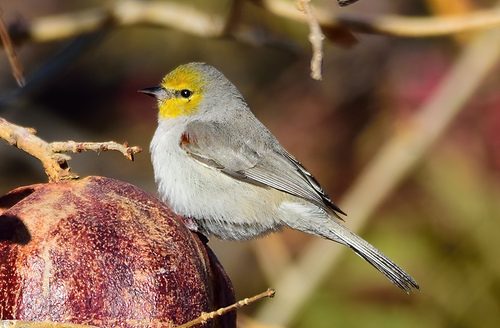
Verdin
Auriparus flaviceps
The Verdin is a tiny but tough desert specialist, recognizable by its bright yellow head and its impressive ability to build insulated stick-fortresses. As the only member of the penduline tit family in North America, it brings a touch of Old World charm to the American Southwest.
Quick Identification
Size
3.5-4.5 in (9-11.5 cm) in length; 6.5 in (16.5 cm) wingspan; 0.18-0.28 oz (5-8 g) in weight
Colors
Adults have a grayish body with a bright yellow head and throat and a small chestnut-red patch on the shoulder. Juveniles are uniformly gray.
Key Features
- Bright yellow face and throat on adults
- Small, sharply pointed black bill
- Chestnut-colored 'shoulder' patch (lesser coverts)
- Smallest songbird in the American Southwest
- Constructs conspicuous globular stick nests
When You’ll See Them
Behavior
Verdins are incredibly active and restless birds, rarely staying in one spot for more than a few seconds. They spend their days flitting through desert scrub, hanging upside down from branches to glean insects from the underside of leaves. Unlike many other small songbirds that migrate, Verdins are hardy residents that stay in their desert territories year-round, surviving intense summer heat and freezing winter nights.
One of their most fascinating behaviors is their architectural skill. They build multiple spherical nests made of thorny twigs and lined with feathers or hair. Some nests are used for raising young, while others serve as 'roosting nests' used strictly for sleeping. These thick-walled structures provide essential insulation against the desert's extreme temperature swings. They are generally solitary outside of the breeding season and can be quite vocal, defending their territory with a series of sharp, rapid whistles.
EverydayEarth exclusive
Camera Tips
To capture the best footage of a Verdin, focus your camera on water and native desert flora. In the arid Southwest, a consistent water source like a shallow birdbath or a slow-dripping fountain is the ultimate lure. Position your camera 3 to 4 feet away from the water at a 45-degree downward angle. Because Verdins are tiny and move exceptionally fast, use a camera with a high trigger speed and a fast frame rate (at least 30fps, though 60fps is better) to avoid capturing nothing but a gray blur.
Look for their distinctive football-shaped stick nests in the forks of thorny trees like Mesquite or Palo Verde. If you find an active nest, place your camera nearby—but never closer than 5-6 feet to avoid disturbing them. Since Verdins use these nests for roosting every night, you can set your camera to record in the late evening to catch them entering their 'bedroom' for the night. This provides a rare look at their nighttime survival strategies.
If you use hummingbird feeders, you are in luck. Verdins have a known 'sweet tooth' and frequently visit nectar feeders to sip sugar water. Mount your camera directly facing a feeder port. They often hover briefly or perch on the edge, providing a great opportunity for the AI to identify their yellow face. For the best lighting, ensure the sun is behind the camera, as their yellow plumage can be washed out by harsh desert backlight.
During the spring, you can attract them into your camera’s field of view by providing nesting materials. While they build the exterior with twigs, they love soft linings. Hanging a small cage with raw cotton or pet fur can lure them in for high-quality close-ups as they gather material to insulate their nests.
Similar Species
Species that look similar or are commonly confused with Verdin.
Frequently Asked Questions
Record Verdin at your habitat
Connect a camera to start building your own species record — AI identifies every visitor automatically.