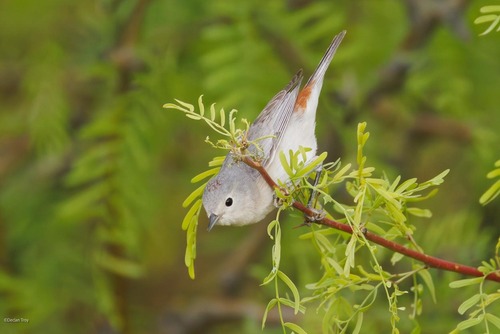
Lucy's Warbler
Leiothlypis luciae
The 'Desert Grayback' is the smallest warbler in North America, a tiny dynamo that thrives in the heat of the Southwest. One of the few warblers to nest in tree cavities, it brings a bright trilling song to mesquite bosques and desert backyards alike.
Quick Identification
Size
Length: 3.5–4.7 in (9–12 cm); Wingspan: 7.5 in (19 cm); Weight: 0.18–0.28 oz (5–8 g)
Colors
Pale gray upperparts and whitish underparts; males feature a small rufous crown patch and rufous rump, which are paler or absent in females.
Key Features
- Smallest warbler in North America
- Pale gray plumage with no wing bars
- Small rufous patch on crown and rump
- Thin, needle-pointed bill
When You’ll See Them
Geographic range
Where Does the Lucy's Warbler Live?
This hardy desert specialist is native to the North American Southwest, with a core breeding range extending across Arizona, New Mexico, southern Utah, and southeastern California. It is also commonly found in the northwestern Mexican states of Sonora and Sinaloa. As a migratory species, it departs its northern breeding grounds in late summer to spend the winter months along the Pacific slope of western Mexico.
Basemap © OpenStreetMap contributors
Behavior
Lucy’s Warbler is a high-energy insectivore that spends much of its time flitting through the dense foliage of desert trees. Unlike many other warblers that prefer the high canopy, Lucy’s often forages in the mid-to-lower levels of mesquite and willow thickets. They are incredibly agile, frequently hovering for a split second to pluck an insect from the underside of a leaf or creeping along bark like a nuthatch in search of hidden larvae.
Socially, they are quite territorial during the breeding season. Males are persistent singers, delivering a bright, rapid trill that can be surprisingly loud for such a tiny bird. They are unique among New World warblers as one of only two species to nest in cavities, often selecting narrow crevices in peeling bark or abandoned woodpecker holes. While they are not particularly shy around humans, their neutral colors and rapid movements make them a rewarding challenge for backyard observers to spot.
EverydayEarth exclusive
Camera Tips
To successfully capture Lucy's Warbler on your backyard camera, focus your efforts on water and nesting sites. In the arid environments they call home, a shallow, dripping birdbath or a misting station is an irresistible magnet. Mount your camera 3 to 4 feet away from the water source at the same height as the basin. Use a high-speed trigger setting, as these birds move exceptionally fast and rarely stay still for more than a few seconds while bathing.
Since Lucy’s Warblers are cavity nesters, you can attract them and get great footage by installing specialized warbler nesting boxes. These boxes have a smaller opening (about 1 to 1.125 inches) than standard bluebird houses. Position your camera to face the entrance hole from a distance of about 5 feet. This is the best way to get clear, front-facing shots of the birds as they arrive with nesting material or food for their chicks. Aim for a south-facing camera orientation to ensure consistent lighting throughout the day without harsh shadows.
For trail camera users, look for mature mesquite trees with peeling bark. Lucy's Warblers love to forage in these crevices. Increase your camera’s sensitivity to its maximum level; because of their small size and pale gray color, they may not always trigger standard PIR sensors at a distance. Setting your camera to take 'burst' photos or short 10-second video clips will give you the best chance of seeing the subtle rufous rump and crown patches that identify the species.
Similar Species
Species that look similar or are commonly confused with Lucy's Warbler.
Frequently Asked Questions
Record Lucy's Warbler at your habitat
Connect a camera to start building your own species record — AI identifies every visitor automatically.