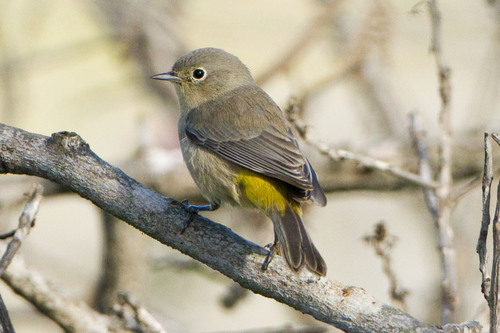
Virginia's Warbler
Leiothlypis virginiae
A subtle gem of the Western scrublands, Virginia’s Warbler blends perfectly into the pinyon-juniper shadows until it reveals a flash of brilliant yellow. Watch for its signature tail-flick as it navigates the mountain thickets.
Quick Identification
Size
Length: 10–12 cm (4–4.7 in); Wingspan: 18–19 cm (7.1–7.5 in); Weight: 7–9 g (0.2–0.3 oz)
Colors
Predominantly gray plumage with a bright yellow patch on the breast and under the tail. Features a conspicuous white eye-ring; males have a small, often concealed reddish-brown crown patch.
Key Features
- Conspicuous white eye-ring
- Bright yellow breast and undertail coverts
- Frequent downward tail-flicking behavior
- Small, thin bill
- Overall pale gray body without wing bars
When You’ll See Them
Behavior
Virginia's Warblers are energetic, restless songbirds known for their distinctive foraging style. Unlike many warblers that haunt the high canopy, these birds are specialists of the undergrowth. They spend much of their time hopping through dense thickets of mountain mahogany or scrub oak, often staying low to the ground. Their most recognizable behavioral trait is a persistent, rhythmic downward flicking of the tail as they move through the brush.
During the breeding season, they are highly territorial and can be heard singing a sweet, loose trill that speeds up toward the end. They are relatively secretive and masterfully camouflaged against the gray-green foliage of their arid habitats. While not particularly social with other species, they are often found in loose mixed flocks during the fall migration as they begin their journey south to Mexico.
EverydayEarth exclusive
Camera Tips
To successfully capture Virginia’s Warbler on an AI camera, location is everything. Because they are ground-nesters and spend the majority of their time in the understory, you should mount your camera low—approximately 12 to 24 inches above the ground. Aim the lens toward a small clearing within a dense patch of native shrubs like scrub oak or serviceberry. This species prefers the interface between dense cover and open ground where they can forage in the leaf litter.
Water is the most effective way to draw these birds into your camera's field of view. Virginia’s Warblers are famously attracted to moving water in arid environments. A shallow birdbath equipped with a dripper or a small, bubbling rock feature will be far more attractive than a static bowl of water. Position your camera about 3-5 feet from the water source to ensure the AI can trigger and focus accurately. If possible, place a attractive perching branch just above the water; these birds usually land there first to scan for predators before hopping down to bathe.
Regarding camera settings, these birds move with a frantic, jittery energy. Use a high shutter speed or a 'burst' photo mode to freeze their frequent tail-flicks and quick head movements. Because their habitat is often characterized by dappled sunlight and deep shadows, ensure your camera is positioned to avoid direct lens flare during the 'Golden Hours' of the early morning when they are most active. In backyards, focus on creating a 'bird highway'—a line of dense shrubs leading toward a water source—and place your camera at the end of that corridor.
Similar Species
Species that look similar or are commonly confused with Virginia's Warbler.
Nashville Warbler
The Nashville Warbler has a vibrant olive-green back and more extensive yellow on its belly, compared to the Virginia's mostly gray body.
Lucy's Warbler
Lucy's is the only other gray warbler in the region but lacks the yellow breast patch, instead featuring a rufous rump and crown.
Colima Warbler
Much larger and browner than Virginia's, the Colima Warbler is restricted to a very small breeding range in the mountains of Big Bend, Texas.
Frequently Asked Questions
Record Virginia's Warbler at your habitat
Connect a camera to start building your own species record — AI identifies every visitor automatically.