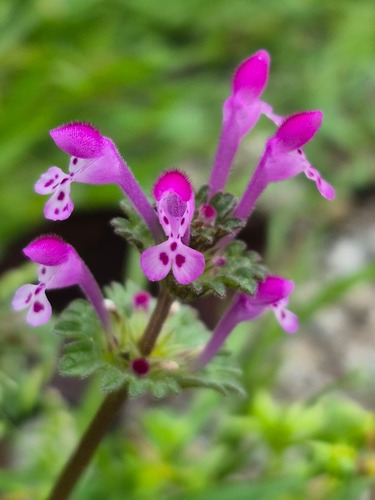
henbit deadnettle
Lamium amplexicaule
The purple herald of spring, henbit deadnettle is a vital lifeline for early-season pollinators. Its unique 'clasping' leaves and hooded flowers make it a fascinating miniature jungle right in your backyard.
Quick Identification
Size
Height: 4–12 inches (10–30 cm); Spread: 6–12 inches (15–30 cm)
Colors
Bright green to reddish-green foliage; tubular pink to deep purple flowers with darker purple spots on the lower lip
Key Features
- Square stems typical of the mint family
- Upper leaves 'clasp' the stem directly without stalks (amplexicaul)
- Tubular pink flowers with a distinct 'hooded' upper petal
- Rounded, scalloped leaves with deep veins
When You’ll See Them
Behavior
Henbit deadnettle is a hardy winter annual that serves as one of the very first signs of life in the late winter landscape. While many consider it a common lawn weed, it plays a vital role in the ecosystem by providing a critical early-season nectar source for honeybees and bumblebees when few other flowers are in bloom. It grows in low-lying mats, spreading quickly across open soil or dormant lawns.
Interestingly, henbit utilizes a clever reproductive strategy involving two types of flowers. In addition to the showy purple blooms we see, it often produces 'cleistogamous' flowers—tiny, petal-less buds that never open and instead self-pollinate. This ensures the plant can reproduce even if the weather is too cold for its insect pollinators to be active. It is non-aggressive toward humans and non-toxic, often being used as an edible herb in foraged salads.
EverydayEarth exclusive
Camera Tips
Because henbit deadnettle is a low-growing plant, your camera placement needs to be at ground level to capture its true beauty. Set your AI-powered camera on a small tripod or use a ground-stake mount just 3 to 5 inches off the turf. Angle the lens slightly upward to catch the 'hooded' shape of the flowers against the sky or a backdrop of green. This 'ant’s-eye view' is perfect for capturing the minute details of the spotted lower petals that are usually missed from a standing height.
If your camera supports time-lapse mode, henbit is a fantastic subject for a 24-hour cycle. You can document the flowers reaching toward the morning sun and the subtle closing of the leaves during the night. For the best color saturation, try to capture images during the 'golden hour'—shortly after sunrise or before sunset—when the soft light makes the pink and purple hues pop against the green square stems.
Use henbit as a natural 'lure' for insect photography. Since this is one of the first nectar sources available, aim your camera at a healthy cluster of blooms on a sunny, still morning (above 50°F). You are highly likely to capture high-definition footage of early-season bees, hoverflies, and even the occasional overwintering butterfly. Set your camera to a high frame rate or 'burst' mode to catch the fast-moving wings of these visitors.
Finally, don't ignore the dew or frost. Henbit's scalloped leaves are excellent at catching morning moisture. If you have a macro lens or a close-focus setting, a frosty spring morning can yield incredible 'crystal' effects on the edges of the leaves. Ensure your camera is protected from ground moisture with a small weather shield or a dry stone base to prevent lens fogging during these early morning sessions.
Similar Species
Species that look similar or are commonly confused with henbit deadnettle.
Frequently Asked Questions
Record henbit deadnettle at your habitat
Connect a camera to start building your own species record — AI identifies every visitor automatically.