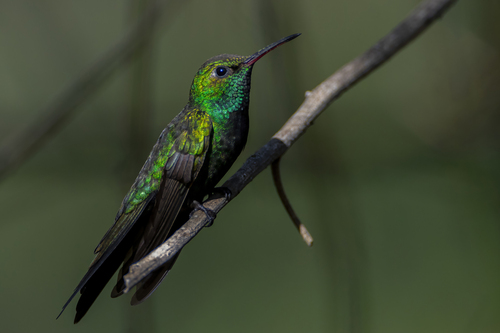
Hispaniolan Emerald
Riccordia swainsonii
A jewel of the Caribbean, the Hispaniolan Emerald is a master of aerial acrobatics endemic to the island of Hispaniola. With its deeply forked tail and shimmering green plumage, this resilient hummingbird is a crown jewel for backyard birders in the Dominican Republic and Haiti.
Quick Identification
Size
Length: 10.5–11.5 cm (4.1–4.5 in); Weight: 4–5 g (0.14–0.18 oz)
Colors
Bronzy-green upperparts; males have a dark blackish breast and green throat; females are pale greyish-white below.
Key Features
- Deeply forked blackish tail
- Large black patch on the breast (males)
- Small white spot behind the eye
- Straight, black bill with pinkish base on lower mandible
When You’ll See Them
Geographic range
Where Does the Hispaniolan Emerald Live?
This vibrant hummingbird is a Caribbean treasure, found exclusively on the island of Hispaniola. Its native range encompasses the diverse landscapes of both the Dominican Republic and Haiti, including several smaller offshore islands like Île de la Gonâve. From the humid lowland coastal forests to the misty heights of the Cordillera Central, the Hispaniolan Emerald is a widespread and common sight across its island home.
Basemap © OpenStreetMap contributors
Behavior
The Hispaniolan Emerald is a spirited and territorial bird, often seen darting between flower clusters with remarkable speed and agility. While smaller than some of its island neighbors, it is surprisingly bold, frequently defending its favorite nectar sources from larger hummingbirds or even insects. During the breeding season, males perform rhythmic aerial displays, though the species does not form long-term pair bonds, with females handling all nesting duties.
In gardens and backyard settings, these emeralds are creatures of habit. They often follow a 'trap-lining' foraging strategy, visiting a specific sequence of flowers at predictable intervals throughout the day. They are relatively comfortable around human activity, provided there is dense foliage nearby where they can retreat if they feel threatened. Their flight produces a low, distinctive humming sound that often alerts observers to their presence before they are seen.
EverydayEarth exclusive
Camera Tips
Capturing the Hispaniolan Emerald on camera requires a high-speed trigger and plenty of natural light to illuminate its iridescent feathers. Position your AI-powered camera within 3 to 5 feet of a red or tubular flower source, such as Hibiscus, Heliconia, or Cape Honeysuckle. Because these birds are highly territorial, they often return to the same 'guard perch'—a bare twig near a food source. If you spot a bird resting in the same spot repeatedly, that is the perfect location to angle your lens.
For the clearest images, set your camera to a burst mode or high-frame-rate video. The wingbeats of an emerald are so fast that a standard single-shot trigger often results in a motion-blurred image. Ensure the camera is positioned at roughly chest height (4-5 feet) and angled slightly upward to capture the shimmering throat (gorget) and the distinctive fork in the tail. Morning light, specifically between 7 AM and 9 AM, offers the best golden-hour glow for their metallic green plumage without the harsh, washing shadows of the midday sun.
If you are using a nectar feeder to attract them, choose a model with a perch. While they are master hovers, they will often land to drink, providing the AI with a stable subject for a much higher-quality identification and photo. Avoid placing your camera in deep shade; the male’s dark breast patch can appear as a flat black blob in low light, whereas direct or dappled sunlight will reveal the intricate feather textures and subtle color shifts.
Similar Species
Species that look similar or are commonly confused with Hispaniolan Emerald.
Frequently Asked Questions
Record Hispaniolan Emerald at your habitat
Connect a camera to start building your own species record — AI identifies every visitor automatically.