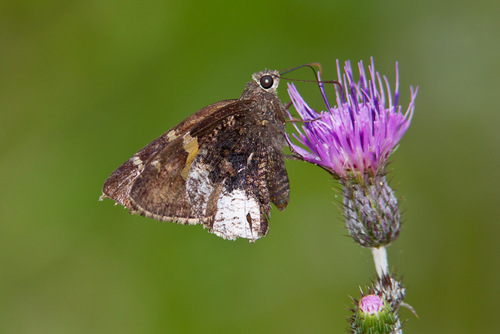
Hoary Edge
Cecropterus lyciades
Meet the Hoary Edge, a swift and elusive forest-edge specialist famous for the 'frosted' white patches on its wings. This robust skipper adds a touch of silvery magic to sun-drenched clearings and backyard gardens alike.
Quick Identification
Size
Wingspan of 4.4 - 5.1 cm (1.75 - 2 inches)
Colors
Rich chocolate brown base; forewing has a band of golden-yellow or amber spots; the underside of the hindwing features a large, blurry, frosted white patch along the outer edge.
Key Features
- Diffuse silvery-white patch on the outer edge of the hindwing underside
- Prominent yellowish-gold transparent spots on the forewings
- Robust, 'chunky' body typical of larger skippers
- Fast, darting flight pattern with frequent perching on low leaves
When You’ll See Them
Behavior
The Hoary Edge is a spirited and powerful flier, often seen darting through sunny clearings and along the edges of deciduous forests with a speed that can make it difficult to track. Unlike many smaller, more delicate butterflies, this species has a robust, muscular build that allows it to navigate thickets and resist light winds. They are most frequently observed when they stop to nectar at flowers or when males are patrolling their territories in search of mates.
A unique behavioral quirk of the Hoary Edge is its perching habit. While many skippers sit on top of flowers, the Hoary Edge often perches on the underside of leaves or on low-hanging branches, hanging vertically. This provides a level of camouflage against predators but makes them a thrilling challenge for backyard observers to spot. When they do settle on flowers, they are energetic feeders, moving quickly between blooms to fuel their high-metabolism flight.
EverydayEarth exclusive
Camera Tips
To capture the Hoary Edge on a trail or backyard camera, placement is everything. Because these butterflies prefer the 'edge' of habitats, position your camera at the transition zone between a wooded area and an open lawn or field. They are low-fliers, so mounting your camera on a short stake just 12 to 24 inches off the ground will yield the best results. Angle the lens slightly upward if you are placing it near known perching spots like low-hanging maple or oak leaves.
Since these butterflies are fast-moving, use a camera with a high-speed trigger or set your AI camera to its most sensitive motion detection setting. If your device allows for 'burst mode,' enable it; the Hoary Edge is most easily identified by the white patch on its hindwing underside, which is often only visible for a split second as it lands or takes off. A high frame rate video setting (60fps or higher) is also an excellent way to capture the 'hoary' detail in slow-motion playback.
Creating a 'puddling station' is a pro-tip for attracting this specific species. Find a sunny spot in view of your camera and create a small patch of damp, sandy soil mixed with a tiny amount of sea salt or compost. Males often visit these spots to intake essential minerals. Additionally, planting their favorite nectar sources like Butterfly Weed or Purple Coneflower in a tight cluster will give the camera a reliable 'target zone' to focus on.
Timing is critical for lighting. The silvery patch on the Hoary Edge can easily be 'blown out' (overexposed) in harsh midday sun. Aim your camera so the sun is behind it or at a 45-degree angle. This sidelighting will highlight the texture of the wings and make the white patch pop against the dark brown body. Early afternoon, when the butterflies are most active but the sun isn't directly overhead, is the prime window for high-quality captures.
Similar Species
Species that look similar or are commonly confused with Hoary Edge.
Frequently Asked Questions
Record Hoary Edge at your habitat
Connect a camera to start building your own species record — AI identifies every visitor automatically.