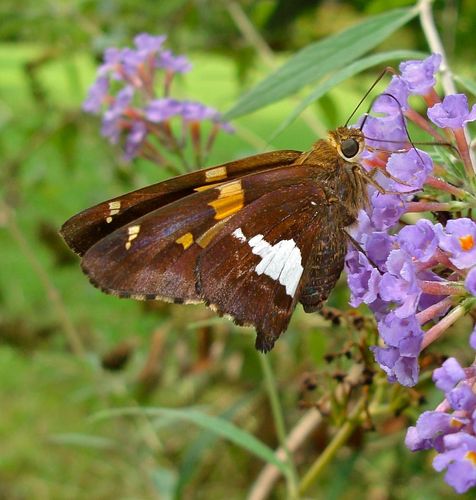
Silver-spotted Skipper
Epargyreus clarus
Don't let the drab brown wings fool you—the Silver-spotted Skipper is a master of disguise with a brilliant metallic secret. Known for its lightning-fast flight and territorial personality, it is one of the most charismatic visitors to the North American backyard.
Quick Identification
Size
Wingspan of 1.75 to 2.6 inches (4.5 to 6.7 cm); large for a skipper species.
Colors
Rich chocolate brown wings with translucent gold/orange spots on the forewings; underside of the hindwing features a large, irregular, brilliant silvery-white patch.
Key Features
- Large, bright silvery-white patch on the underside of the hindwing
- Deep chocolate brown base color
- Prominent, hooked 'apiculi' on the ends of the antennae
- Extremely fast, darting flight pattern
When You’ll See Them
Behavior
The Silver-spotted Skipper is often described as the 'fighter jet' of the butterfly world. Unlike the slow, rhythmic flapping of a Monarch, this skipper moves with a rapid, erratic 'skipping' motion that can make it difficult to follow with the naked eye. Males are notoriously territorial; they will choose a prominent perch on a leaf and dart out to investigate or chase away any perceived intruders, including other butterflies, bees, or even humans who venture too close to their sunny spot.
Despite their aggressive flight, they are docile when feeding. They are frequent visitors to backyard gardens, where they can be seen 'puddling' on damp ground to extract minerals or nectar-feeding with their long proboscis. When they land, they often hold their wings in a unique position—the forewings are held partially open while the hindwings are spread flatter—though they will close them tightly when resting, which is when their namesake silver patch is most visible.
EverydayEarth exclusive
Camera Tips
Capturing the Silver-spotted Skipper on a backyard camera requires precision and timing. Because they are so small and fast, traditional motion-trigger settings on trail cameras often fail to activate quickly enough, resulting in photos of empty flowers. To solve this, set your camera to 'Time Lapse' mode during the peak hours of 11:00 AM to 2:00 PM, taking a shot every 5 to 10 seconds. This increases your chances of catching one mid-feed or while it is perched on a favorite leaf.
Position your camera approximately 15 to 20 inches away from a cluster of nectar-rich flowers. Purple and pink blooms like Buddleia (Butterfly Bush), Joe-Pye Weed, or Lavender are absolute magnets for this species. Ensure the camera is mounted at the same horizontal level as the flower heads; shooting from a downward angle often misses the crucial side-profile view needed to see the silver spot on the underside of the wing. If your camera has a macro or close-focus setting, now is the time to use it to capture the fine detail of their 'furry' bodies and hooked antennae.
Lighting is the most important factor for showcasing this skipper's unique features. The silver patch on their hindwing is highly reflective and iridescent. Position your camera so the sun is behind it, shining directly onto the target flowers. This 'front-lighting' will make the silver patch glow and help the dark brown wings stand out against the green foliage. If you have Wisteria or Black Locust in your yard, consider placing a second camera near the leaves to capture the larvae, which build unique shelters by silk-taping leaves together—a fascinating behavior rarely seen without dedicated monitoring.
Similar Species
Species that look similar or are commonly confused with Silver-spotted Skipper.
Frequently Asked Questions
Record Silver-spotted Skipper at your habitat
Connect a camera to start building your own species record — AI identifies every visitor automatically.