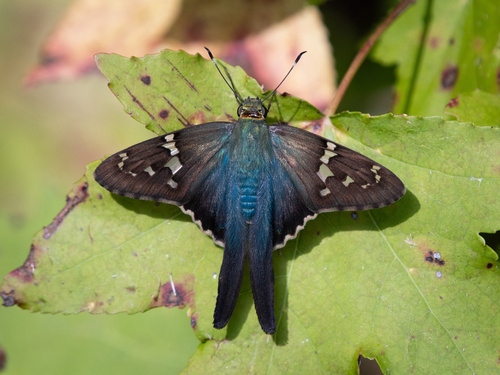
Long-tailed Skipper
Urbanus proteus
A shimmering jewel of the backyard, the Long-tailed Skipper dazzles with its iridescent blue body and elegant, trailing wing extensions. Watch for this agile flyer as it darts between your garden's favorite nectar-rich blooms.
Quick Identification
Size
Wingspan of 4.5 to 6 cm (1.8 to 2.4 inches)
Colors
Chocolate brown wings with translucent white spots; body and wing bases are covered in brilliant iridescent blue-green scales; underwings are patterned with dark brown bands.
Key Features
- Long, slender tails extending from the hindwings
- Iridescent blue-green dorsal body and wing bases
- Square, translucent white spots on the forewings
- Robust 'skipper' body with large eyes and a large head
- Spread-winged resting posture
When You’ll See Them
Behavior
The Long-tailed Skipper is a fast and erratic flyer, often appearing as a dark blur as it zips between nectar sources. Unlike many other skippers that rest with their wings partially closed in a 'V' shape, this species is a spread-winged skipper, frequently basking in the sun with its wings fully extended to display its shimmering blue scales. They are highly active during the hottest parts of the day and can be quite territorial, chasing away other butterflies from their favorite flowers.
In the larval stage, they are known as 'Bean Leafrollers.' They exhibit a unique behavior where the caterpillar cuts a small flap of a leaf, folds it over itself, and secures it with silk to create a protective tent. They spend most of their time inside these shelters, emerging only to feed. This makes them easy to spot in a vegetable garden if you know what to look for—just find the folded bean leaves!
EverydayEarth exclusive
Camera Tips
To capture the Long-tailed Skipper on your backyard camera, location is everything. These butterflies are drawn to 'anchor' plants in the garden. Position your camera about 12 to 18 inches away from a cluster of nectar-rich flowers like Zinnias or Lantana. If your AI camera has a macro mode or adjustable focus, ensure it is set for a narrow field of view to capture the intricate details of the wing spots and the iridescence of the body.
Lighting plays a crucial role in seeing the 'glow' of this species. Aim your camera so the sun is behind it, illuminating the butterfly's back (the dorsal side). The iridescent blue scales reflect light best during mid-day when the sun is high. If the camera is aimed into the sun, the butterfly will appear as a dark silhouette, and you'll miss its most striking feature. A background of dark green foliage will also help the blue and brown colors pop in your captures.
Because skippers move very quickly, use a high-speed shutter or 'burst mode' if your camera settings allow. They often hover for a split second before landing, which is the perfect time for a motion-activated trigger to fire. If you are specifically looking to capture the 'Bean Leafroller' caterpillars, place a camera near your garden bean plants. Look for the distinctive folded leaves and set your camera to a time-lapse mode to see if you can catch the larva emerging to feed or constructing its silk-tied home.
Similar Species
Species that look similar or are commonly confused with Long-tailed Skipper.
Frequently Asked Questions
Record Long-tailed Skipper at your habitat
Connect a camera to start building your own species record — AI identifies every visitor automatically.