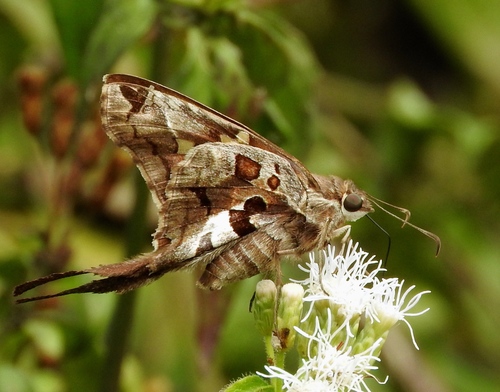
Zilpa Longtail
Chioides zilpa
A master of high-speed maneuvers, the Zilpa Longtail is easily recognized by its elegant hindwing tails and a brilliant flash of silver on its underside. This robust skipper brings a touch of tropical energy to sunny backyard gardens.
Quick Identification
Size
Wingspan of 1.75 to 2.25 inches (4.5 to 5.7 cm)
Colors
Rich chocolate brown upper wings; the underside of the hindwing features a striking, broad silvery-white median band. Fringes are typically checkered with brown and white.
Key Features
- Elongated, prominent tails on the hindwings
- A bold, bright silvery-white band across the underside hindwing
- Dark brown coloration without iridescent blue/green scales
- Large, robust body with a rapid, darting flight style
When You’ll See Them
Behavior
The Zilpa Longtail is a member of the skipper family, named for their characteristic fast, powerful, and erratic flight patterns. Unlike the steady flapping of a Monarch, this species appears to "skip" through the air, making them a challenge to track with the naked eye. They are highly active during the hottest parts of the day, frequently darting between nectar sources with incredible precision.
When resting, they often exhibit a unique posture known as the "jet-plane" position, where the forewings are held upright while the hindwings are spread flat. This behavior is thought to help with thermoregulation. While they are generally solitary, you may find several individuals congregating around a particularly rich nectar source or a "puddling" spot where they sip moisture and minerals from damp soil.
EverydayEarth exclusive
Camera Tips
To capture high-quality images of the Zilpa Longtail, you must account for their speed. These butterflies don't linger long in one spot. Set your AI-powered camera near high-nectar "anchor" plants like Lantana or Butterfly Bush. Because they are low-fliers, mount your camera on a short tripod or stake only 12 to 24 inches off the ground. Aim for a side-on angle rather than top-down; the most important identification feature is the silver band on the underside of the wing, which is only visible when the butterfly perches or closes its wings.
Lighting is your best friend when photographing skippers. The Zilpa Longtail's chocolate brown wings can look muddy in the shade, but in direct sunlight, the textures and the silver band really shine. Position your camera so the sun is behind the lens, illuminating the flower head directly. If your camera supports it, use a high shutter speed or a specialized "small animal" trigger mode to minimize motion blur during their rapid take-offs.
Consider creating a "puddling station" to lure them into a specific frame. A shallow tray filled with sand, kept consistently damp with a mix of water and a tiny pinch of sea salt, can attract males looking for minerals. Place the camera focused on the edge of this damp sand. This provides a rare opportunity to capture the Zilpa Longtail while it is stationary for several minutes at a time, allowing for much crisper detail than you would get at a flower.
Similar Species
Species that look similar or are commonly confused with Zilpa Longtail.
Frequently Asked Questions
Record Zilpa Longtail at your habitat
Connect a camera to start building your own species record — AI identifies every visitor automatically.