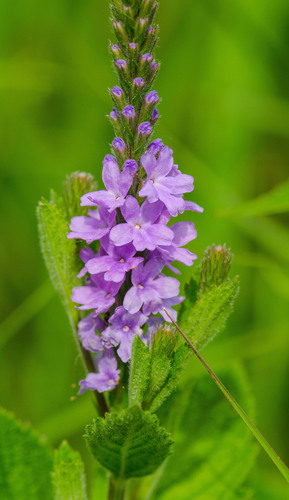
hoary vervain
Verbena stricta
Rugged, radiant, and remarkably resilient, Hoary Vervain is the ultimate summer survivor. Its velvety purple spikes serve as a high-traffic airport for the most beautiful butterflies in your neighborhood.
Quick Identification
Size
Stands 1 to 3 feet (30–90 cm) tall, occasionally reaching 4 feet; leaves are 2–4 inches (5–10 cm) long.
Colors
Lavish spikes of lavender to deep purple flowers; foliage is a distinct grayish-green due to dense white hairs.
Key Features
- Densely hairy, 'woolly' stems and leaves
- Tall, slender flower spikes with blooms opening in a ring
- Opposite, oval-shaped leaves with heavy serration
- Deeply veined, stalkless leaves that clasp the stem
When You’ll See Them
Behavior
Hoary Vervain is a resilient perennial wildflower that acts as a social hub for backyard biodiversity. Unlike many garden plants that wither under intense heat, this species thrives in full sun and dry conditions. It is famously 'unpalatable' to most mammals like deer and rabbits due to its bitter leaves, which allows it to stand tall in areas where other vegetation might be grazed away.
Its most fascinating behavior is its blooming pattern. The tiny, tubular flowers begin blooming at the bottom of the long spike and slowly march upward throughout the summer, creating a 'ring of fire' effect in shades of violet. This staggered blooming ensures a steady supply of nectar for local pollinators over several months, making it a reliable food source in the height of summer.
EverydayEarth exclusive
Camera Tips
To capture the true beauty of Hoary Vervain with an AI-powered camera, focus on the 'pollinator parade.' Position your camera on a steady tripod about 18–24 inches from a cluster of flowering spikes. Because the plant is a magnet for Great Spangled Fritillaries and Silver-spotted Skippers, use a high-shutter-speed setting to freeze the motion of wings. Angle the lens slightly upward to catch the purple spikes against the blue sky for a professional, high-contrast look.
For those using AI-triggering features, set the sensitivity to detect small fast-moving objects. Hoary Vervain is one of the best plants for 'insect logging' because bees and butterflies tend to linger on the individual florets. If your camera supports time-lapse, set it to take a frame every hour over the course of a week; you will be able to see the ring of flowers literally climbing the spike as the season progresses.
Placement is key for lighting. Avoid deep shade, as the grayish 'hoary' leaves can look muddy in low light. The silvery hairs on the leaves catch the golden hour light beautifully, so try to orient your camera facing east or west to capture that backlit glow. If you are monitoring for herbivores, you may notice that while deer avoid the leaves, birds like Goldfinches may visit in late autumn to pick at the drying seed heads—keep your cameras out even after the purple fades!
Similar Species
Species that look similar or are commonly confused with hoary vervain.
Frequently Asked Questions
Record hoary vervain at your habitat
Connect a camera to start building your own species record — AI identifies every visitor automatically.