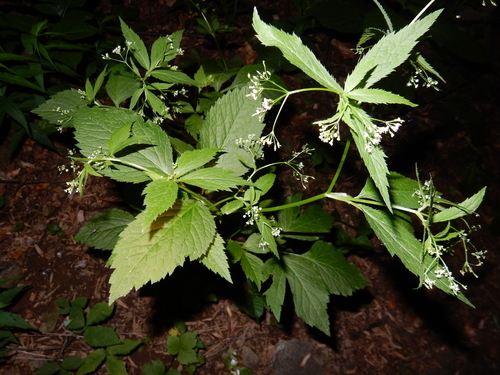
honewort
Cryptotaenia canadensis
Often mistaken for a common weed, Honewort is actually a versatile native perennial that brings a touch of wild elegance to shaded landscapes. Known for its parsley-like flavor and delicate summer blooms, it is a must-have for any backyard enthusiast looking to support native pollinators.
Quick Identification
Size
Grows 30-90 cm (12-36 inches) tall with a spread of roughly 30-60 cm (12-24 inches).
Colors
Bright, vibrant green foliage; tiny white flowers; stems may show light ribbing in a pale green or reddish tint.
Key Features
- Leaves divided into three distinct leaflets (trifoliate)
- Leaflets have sharp, irregular teeth or lobes
- Tiny white flowers arranged in sparse, irregular umbrella-like clusters
- Hollow, aromatic stems that smell faintly of carrot or celery
When You’ll See Them
Geographic range
Where Does the honewort Live?
Honewort is a widespread native of North America, stretching across the eastern half of the continent. Its territory reaches from the maritime provinces of Canada down to the Gulf Coast of the United States, and as far west as the Great Plains. It is most commonly encountered in the temperate broadleaf forests of the Appalachian region and the Midwest, where consistent moisture and shade allow it to thrive.
Basemap © OpenStreetMap contributors
Behavior
Honewort is a resilient perennial that acts as a quiet anchor for the woodland floor. Emerging in early spring, it quickly establishes a lush, leafy presence before most trees have fully leafed out. It follows a steady growth cycle, reaching its full height by mid-summer when it sends up slender stalks topped with delicate, airy flower clusters. Unlike many garden herbs, it maintains a tidy, clump-forming habit that doesn't become overly aggressive.
As a member of the carrot family, Honewort plays a vital role in the local ecosystem by providing a nectar source for specialized pollinators. Small hoverflies, parasitic wasps, and native bees are frequent visitors to its tiny blooms. In the late summer and autumn, the plant focuses on seed production, releasing curved, oblong seeds that will germinate the following spring to continue the cycle.
EverydayEarth exclusive
Camera Tips
To get the best shots of Honewort, position your camera on a low tripod or ground mount, roughly 1 to 2 feet above the soil. This perspective highlights the characteristic 'three-leaf' structure and allows you to capture the delicate white flowers against a soft-focus background. Because this plant thrives in dappled shade, use a camera with good dynamic range or adjust your exposure compensation slightly lower (-0.5 or -1.0) to prevent the white flowers from looking like bright white spots in the sun.
Setting your camera to time-lapse mode is a fantastic way to document this species. During the peak growth months of May and June, a photo taken every few hours can capture the 'circadian' movement of the leaves as they track the light. If you are interested in the 'wildlife' aspect of this plant, focus your camera on the flower umbels with a fast trigger speed. You'll likely capture a surprising variety of tiny, beneficial insects that are often too small to see with the naked eye.
Placement is key; look for Honewort in the dampest, most shaded corners of your yard, particularly near the base of oak or maple trees. If you have a trail camera with a macro lens or a close-focusing distance, aim for the leaf axils where the stems meet. During the autumn, don't move the camera; the changing colors of the foliage and the development of the seeds provide a wonderful seasonal progression that tells the full story of your backyard's micro-ecosystem.
Similar Species
Species that look similar or are commonly confused with honewort.
Frequently Asked Questions
Record honewort at your habitat
Connect a camera to start building your own species record — AI identifies every visitor automatically.