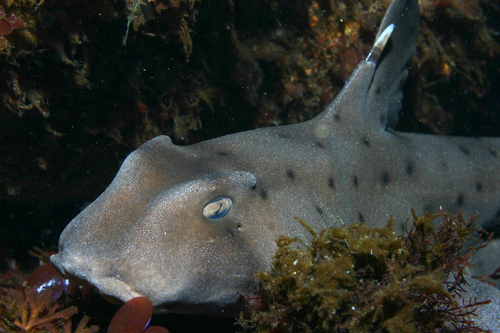
Horn Shark
Heterodontus francisci
Meet the seafloor specialist with a pig-like snout and defensive spines. The Horn Shark is a docile, nocturnal wanderer of the California kelp forests, famous for its ability to 'walk' on its fins.
Quick Identification
Size
Typically 70–100 cm (2.3–3.3 ft) in length; maximum weight around 10 kg (22 lbs).
Colors
Tan, gray, or yellowish-brown base color with numerous small, dark brown or black spots scattered across the body and fins; the underside is typically pale or white.
Key Features
- High ridges over the eyes (supraorbital ridges)
- Two prominent dorsal fins, each featuring a sharp, venomous spine at the front edge
- Short, blunt head with a pig-like snout
- Paddle-like pectoral fins used for 'walking' along the seafloor
When You’ll See Them
Sightings on EverydayEarth
Mar 27, 2026
A Horn Shark swims gracefully across the sandy seafloor after emerging from the dense kelp. Its distinctive blunt snout and dark spots against a tan body are clearly visible as it passes close to the camera lens.
Geographic range
Where Does the Horn Shark Live?
The Horn Shark is a characteristic resident of the eastern Pacific Ocean's coastal waters. Its range is concentrated along the western coast of North America, stretching from central California near Monterey Bay down to the southern tip of Baja California and into the Gulf of California. While they are most abundant in the warm-temperate to subtropical waters of Southern California, they remain strictly coastal and rarely venture far from the continental shelf.
Basemap © OpenStreetMap contributors
Recorded on EverydayEarth
Behavior
The Horn Shark is a sluggish, nocturnal species that spends the majority of its daylight hours tucked away in rocky crevices or deep within the shadows of kelp forests. Unlike many other shark species that must remain in motion to breathe, the Horn Shark uses a method called buccal pumping to actively pull water over its gills, allowing it to remain perfectly still for hours. They are highly site-attached, often returning to the same sheltered 'home' crevice every morning after a night of foraging.
At night, these sharks emerge to hunt along the seafloor. They are not strong swimmers; instead, they use their muscular pectoral fins to 'crawl' over rocks and sand in search of prey. While generally solitary, they may be found in close proximity to others in areas with abundant shelter. To humans, they are docile and non-aggressive, though their dorsal spines serve as a potent deterrent against larger predators like elephant seals and larger sharks.
EverydayEarth exclusive
Camera Tips
Capturing high-quality footage of a Horn Shark requires a specialized underwater camera housing or a dedicated marine trail camera. To maximize your chances, place the camera near 'structure'—specifically the interface where a rocky reef meets a sandy patch. Horn Sharks are creatures of habit; if you find a rocky crevice that looks like a suitable 'den,' there is a high probability the shark will return to that exact spot daily. Mount the camera low, only a few inches off the seabed, as these sharks rarely swim high into the water column.
Because they are strictly nocturnal, your camera's infrared (IR) or low-glow LED performance is critical. They are generally unfazed by artificial light, but using a red-light filter can help capture natural foraging behavior without startling the shark's prey. To draw a shark into the frame, you can use a 'bait box'—a perforated container filled with crushed sea urchins or oily fish like mackerel. Secure the bait box directly in front of the lens to capture the shark's unique 'walking' locomotion and crushing jaw action.
Be extremely cautious with tidal movements and surge when setting your gear. Use a weighted baseplate or heavy-duty dive weights to ensure the camera doesn't shift in the current. In Southern California, the best time to see them in very shallow water (shallow enough for shore-based camera placement) is during the summer breeding season, when you might also spot their unique, spiral-shaped egg cases wedged into rock crevices.
Similar Species
Species that look similar or are commonly confused with Horn Shark.
Frequently Asked Questions
Record Horn Shark at your habitat
Connect a camera to start building your own species record — AI identifies every visitor automatically.