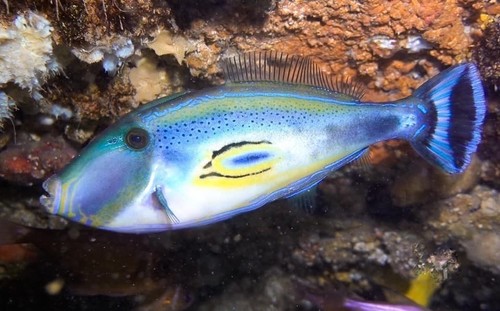
Horseshoe Leatherjacket
Meuschenia hippocrepis
Defined by its striking blue iridescence and a signature horseshoe mark, this inquisitive filefish is a master of the Australian reef.
Quick Identification
Size
Grows to a maximum length of 51 cm (20 in) and typically weighs between 0.6 and 1.3 kg (1.3–2.9 lbs).
Colors
Base color ranges from greyish-green to bright yellow-orange. Males feature vibrant iridescent blue spots and lines on the face and fins. Both sexes share a distinct dark, horseshoe-shaped mark on their sides.
Key Features
- Prominent dark horseshoe-shaped marking on the flank
- Retractable first dorsal spine with a smaller second spine
- Compressed, deep-bodied shape with a small, pouty mouth
- Bright blue facial streaks and spots (most prominent in males)
When You’ll See Them
Geographic range
Where Does the Horseshoe Leatherjacket Live?
The Horseshoe Leatherjacket is a native specialist of the temperate waters surrounding the southern and western coasts of Australia. Its core range extends from the central coast of New South Wales, around the southern coastline including Tasmania, and up to the central coast of Western Australia. This species is strictly endemic to the eastern Indian Ocean and the Great Australian Bight, thriving in cool, nutrient-rich coastal environments.
Basemap © OpenStreetMap contributors
Behavior
The Horseshoe Leatherjacket is a territorial and inquisitive resident of the reef. Unlike many fish that school for protection, these filefish are usually solitary or found in bonded pairs. They are master navigators of complex underwater terrain, using their dorsal and anal fins to hover and maneuver with surgical precision through kelp forests and rocky crevices. They are well-known among divers for their 'bravery,' often approaching humans to investigate, though they remain wary of sudden movements.
When threatened, the Horseshoe Leatherjacket employs a unique mechanical defense. It retreats into a small cave or crevice and 'locks' its large dorsal spine in an upright position. This wedges the fish firmly into the rocks, making it nearly impossible for a predator—like a larger snapper or a shark—to dislodge them. During the day, they spend the majority of their time grazing on the reef, while at night they find a secure spot to rest, often camouflaging against the seaweed.
EverydayEarth exclusive
Camera Tips
To capture high-quality footage of a Horseshoe Leatherjacket, you will need a submersible camera or an action camera in a waterproof housing. If you have a backyard dock or live near a rocky pier, mounting your camera to a fixed structure like a piling or a weighted tripod on the seafloor is the best approach. Position the lens about 1 to 3 meters deep, facing a section of reef or a cluster of sea anemones and sponges where these fish naturally forage.
These fish are naturally attracted to movement and contrast. Using a 'bait cage' filled with crushed mollusks or sea urchins can draw them into the frame, but often just the presence of the camera housing is enough to pique their curiosity. For the best color results, film during the middle of the day when the sun is directly overhead; this illuminates the brilliant blue facial markings and the signature horseshoe mark that otherwise might look dark in deep water.
Because leatherjackets move with a fluttering motion of their fins, use a high frame rate (60fps or higher) to avoid motion blur. If your camera allows for custom white balance, set it for underwater use (red filter or 'dive mode') to counteract the green tint of temperate Australian waters. Ensure your camera is securely tethered, as tidal currents and large swells can easily shift a lightweight camera setup. Check the lens for biofouling or salt spray every few days if the camera is part of a semi-permanent installation.
Similar Species
Species that look similar or are commonly confused with Horseshoe Leatherjacket.
Frequently Asked Questions
Record Horseshoe Leatherjacket at your habitat
Connect a camera to start building your own species record — AI identifies every visitor automatically.