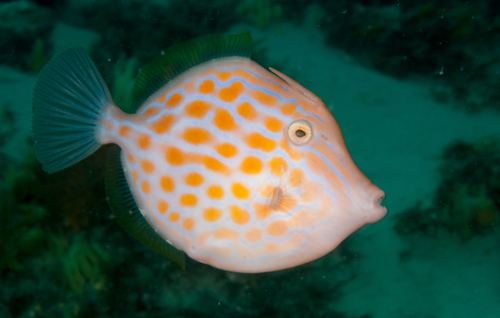
Mosaic Leatherjacket
Eubalichthys mosaicus
Adorned with a mesmerizing tapestry of blue and gold, the Mosaic Leatherjacket is a masterpiece of the Australian reef. This gentle, deep-bodied fish is a highlight for any underwater observer along the southern coastline.
Quick Identification
Size
Typically 30-60 cm (12-24 inches) in length; weight usually ranges from 0.8-2 kg (1.8-4.4 lbs).
Colors
Pale blue to silvery base color adorned with an intricate 'mosaic' of wavy yellow, orange, and brown lines; fins often feature brilliant neon blue margins.
Key Features
- Deep, diamond-shaped body profile
- Intricate maze-like pattern of blue and yellow lines
- Small, powerful mouth with protruding teeth
- Long dorsal and anal fins frequently edged in electric blue
When You’ll See Them
Geographic range
Where Does the Mosaic Leatherjacket Live?
The Mosaic Leatherjacket is a quintessential inhabitant of Australia's temperate marine waters. This species is endemic to the southern half of the Australian continent, with a distribution that spans from the coastal waters of central New South Wales, wrapping around the southern coast through Victoria and South Australia, and extending up to the central coast of Western Australia. They are most frequently encountered in the clear, cool waters of the Great Southern Reef, particularly in areas with significant rocky relief or healthy kelp forests.
Basemap © OpenStreetMap contributors
Behavior
Mosaic Leatherjackets are generally solitary or found in pairs, moving with a graceful, fluttering motion through coastal reef environments. Unlike many fish that use their tails for primary propulsion, leatherjackets primarily use their dorsal and anal fins to maneuver, allowing them to hover and pivot with high precision. They are naturally inquisitive but often maintain a respectful distance from larger creatures, including divers.
These fish spend the majority of their daylight hours foraging across rocky substrates and vertical structures like pier pylons. They are not highly territorial, but they do establish home ranges where they return to favored resting spots among seaweeds or rocky crevices at night. While they are relatively shy, they can become quite bold if they identify a consistent food source, making them a favorite for underwater camera enthusiasts.
EverydayEarth exclusive
Camera Tips
To capture high-quality footage of a Mosaic Leatherjacket in your 'waterfront backyard,' you will need a waterproof action camera or a specialized underwater housing. For the best results, mount the camera to a stable structure such as a jetty pylon or a heavy weighted tripod on a sandy patch adjacent to a reef. Position the camera at a depth of 2 to 5 meters, as this is the primary foraging zone where light penetration is still high enough to capture their vibrant colors without heavy filtration.
Attracting these fish to your lens is most effectively done using a mesh 'burley' bag. Fill the bag with crushed mussels, sea urchins, or oily fish scraps and secure it approximately 1 meter in front of the camera. The Mosaic Leatherjacket’s natural curiosity and keen sense of smell will draw it in to investigate the scent. Because they have small mouths and nip at their food, they will often linger in front of the camera for extended periods, providing excellent opportunities for close-up shots of their intricate patterns.
Lighting is the most critical factor for success. Underwater, colors like red and orange are absorbed quickly; therefore, using an external LED video light is highly recommended to reveal the stunning yellow and blue 'mosaic' patterns. Set your camera to a high frame rate (60fps or higher) to capture the delicate, undulating movements of their fins. If you are recording in an area with tidal movement, aim to film during 'slack water' (the period between high and low tide) to minimize particulates in the water and ensure maximum clarity.
Similar Species
Species that look similar or are commonly confused with Mosaic Leatherjacket.
Frequently Asked Questions
Record Mosaic Leatherjacket at your habitat
Connect a camera to start building your own species record — AI identifies every visitor automatically.