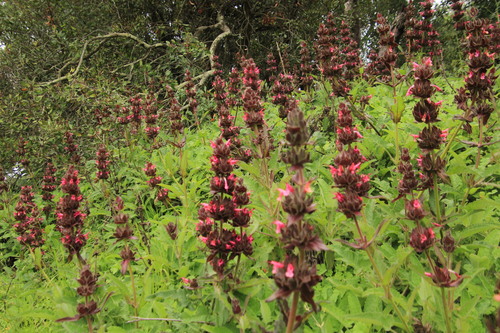
Hummingbird Sage
Salvia spathacea
A fragrant, magenta-flowered treasure of the California coast, Hummingbird Sage is a magnetic centerpiece for backyard pollinators. Its pineapple-scented leaves and tiered blossoms create a high-energy nectar station that hummingbirds simply can't resist.
Quick Identification
Size
1 to 3 feet (0.3–0.9 meters) tall; spreads 2 to 4 feet (0.6–1.2 meters) wide via rhizomes.
Colors
Vibrant rose-lilac to magenta flowers; dark purple or brownish-red pitcher-like bracts; bright green quilted foliage.
Key Features
- Tiered clusters of tubular magenta flowers
- Large, arrow-shaped leaves with a fuzzy, wrinkled texture
- Distinctive fruity, pineapple-like fragrance
- Pitcher-like bracts that hold flowers in distinct stacks.
When You’ll See Them
Behavior
Hummingbird Sage is a resilient perennial that acts as a foundational species in California woodland gardens. Unlike many other salvias that stand tall and airy, this species forms a dense, lush carpet of foliage that spreads slowly through underground rhizomes. It is famous for its 'pitcher-like' flowering spikes, where blossoms emerge from stacked, fuzzy dark husks. This growth habit makes it an excellent groundcover for stabilizing soil and suppressing weeds under the shade of larger trees.
Ecologically, this plant is a powerhouse for local biodiversity. Its tubular flowers are evolutionarily designed for the long bills of hummingbirds, providing a high-energy nectar source during the spring months. While it is tough and drought-tolerant, it spends the hot summer months in a semi-dormant state, waiting for the winter rains to trigger a fresh flush of aromatic, quilted leaves. In a backyard setting, it is a peaceful resident that requires very little maintenance once established, rewarding gardeners with a sweet, fruity scent whenever the leaves are brushed.
EverydayEarth exclusive
Camera Tips
To capture high-quality footage of wildlife using your Hummingbird Sage, the most important factor is the angle of your camera relative to the flower spikes. Because the flowers are tubular and tiered, hummingbirds will hover at specific 'stations' along the stalk. Position your camera on a tripod or mount at a height of about 2 to 3 feet, looking slightly downward at the most vibrant flower cluster. This ensures you catch the bird's head and beak as it probes deep into the blossom for nectar.
Since hummingbirds move at incredible speeds, standard motion-trigger settings on many cameras might only catch a blur or a retreating tail. If your camera allows, use a high-speed video mode or a 'burst' photo setting. If you are using an AI-powered camera like those from EverydayEarth, set the sensitivity to high and ensure the field of view is tight on the flowers to minimize false triggers from wind-blown leaves. Background choice is also key; try to position the camera so that the magenta flowers pop against a shaded, dark background to make the iridescent feathers of the birds stand out.
Lighting can be tricky in the partial shade that this sage prefers. The best footage is usually captured during the 'golden hours'—shortly after sunrise or just before sunset—when the light is soft. Avoid mid-day sun which can create harsh shadows on the quilted leaves and wash out the deep colors of the flowers. If your camera is in a particularly breezy spot, the large leaves of the Salvia spathacea can cause constant false triggers; consider using a 'zone' setting to only trigger recording when something enters the space directly around the floral spikes.
Finally, don't forget the seasonal transition. While the blooms are the main event, many small birds and insects visit the dried stalks later in the year to forage for seeds or nesting material. Keep your camera active even after the magenta petals have dropped. You might capture fascinating behaviors from goldfinches or scrub jays investigating the sturdy, dried 'pitchers' for hidden snacks or spiders.
Similar Species
Species that look similar or are commonly confused with Hummingbird Sage.
Black Sage
Black Sage has smaller, narrower leaves and white-to-light blue flowers, and prefers full sun compared to the shade-loving Hummingbird Sage.
Cleveland Sage
Cleveland Sage grows in a rounded shrub form with grey-green leaves and spherical blue-purple flower whorls, rather than the low-growing magenta spikes of Hummingbird Sage.
Frequently Asked Questions
Record Hummingbird Sage at your habitat
Connect a camera to start building your own species record — AI identifies every visitor automatically.