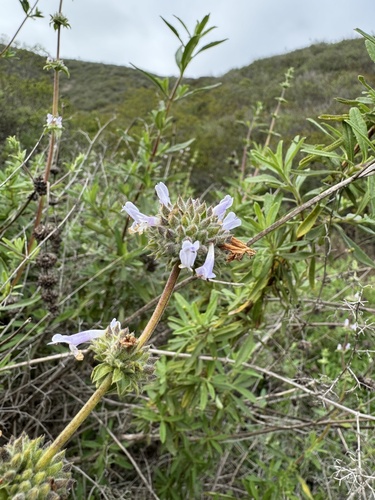
black sage
Salvia mellifera
The aromatic heartbeat of the California coast, Black Sage is a sun-loving shrub that transforms dry hillsides into a bustling sanctuary for hummingbirds and bees.
Quick Identification
Size
A rounded shrub typically reaching 1–2 meters (3.3–6.6 feet) in height and width.
Colors
Dark green, textured leaves with flower spikes featuring whorls of white, pale lavender, or light blue blossoms.
Key Features
- Highly aromatic scent released when leaves are touched
- Dark green, oblong leaves with a pebbled or rugose texture
- Flowers arranged in distinct, separated whorls along the stem
- Square stems typical of the Mint (Lamiaceae) family
When You’ll See Them
Geographic range
Where Does the black sage Live?
Black Sage is a proud native of the Pacific coast of North America, specifically concentrated within the California Floristic Province. Its range extends from the San Francisco Bay Area southward through the coastal ranges and Transverse Ranges of Southern California, continuing across the border into northern Baja California, Mexico. It is most commonly found on sun-drenched slopes within 100 miles of the coastline, where it forms a major component of the coastal sage scrub ecosystem.
Basemap © OpenStreetMap contributors
Behavior
Black Sage is a foundational species of the coastal sage scrub community, known for its incredible resilience and relationship with local pollinators. As a drought-deciduous plant, it has a unique way of handling the Mediterranean climate of its home; during the hot, dry summer months, it may appear dark and almost scorched, dropping its larger leaves to conserve water. This "resinous" appearance is what gives the plant its common name. When the rains return, it undergoes a vibrant transformation, pushing out fresh green growth and preparing for its spectacular spring bloom.
For humans and wildlife alike, the most striking behavior of Black Sage is its aromatic output. The plant is rich in volatile oils, which serve as a defense against browsing herbivores while creating a scent that defines the California wilderness. While it doesn't move like an animal, its life cycle is highly active; it is often the busiest spot in a garden, acting as a social hub for honeybees, bumblebees, and hummingbirds that compete for its high-quality nectar. Its deep root system also plays a vital role in soil stabilization on steep coastal hillsides.
EverydayEarth exclusive
Camera Tips
To capture the true beauty of Black Sage, position your camera to focus on the flower whorls during the peak blooming months of spring. Since the plant is a magnet for fast-moving pollinators, use a camera with a high shutter speed or a specific 'action' mode to freeze the motion of visiting Anna's Hummingbirds or various native bees. A tripod is essential if you are aiming for macro shots of the intricate blossoms, as even a light breeze can cause the flexible stems to sway out of focus.
For those interested in the 'wildlife hub' aspect, place your camera roughly 3 to 5 feet away from a healthy cluster of blooms, angled slightly upward to catch the underside of the flowers where birds often hover. If your camera supports time-lapse photography, Black Sage is a fantastic subject; a 24-hour cycle can capture the dramatic opening of new buds in the morning and the heavy traffic of pollinators throughout the heat of the day. Avoid using heavy flashes at night, as the resinous leaves can create a harsh glare that washes out the image.
Pay close attention to the background of your shot. Because Black Sage has a dark, dense structure, try to frame it against a clearer background or the open sky to make the pale flower spikes pop. If you are using an AI-powered camera like those featured on EverydayEarth, ensure the lens is clean of the sticky resins that the plant sometimes releases into the air, which can smudge the glass over time. Early morning light, or 'golden hour,' is the best time for photography, as the low sun catches the fine hairs on the leaves and makes the nectar-filled flowers glow.
Similar Species
Species that look similar or are commonly confused with black sage.
White Sage
Much larger, bright white/silvery leaves and taller, more elongated flower stalks.
Purple Sage
Light gray-green foliage and larger, more vibrant purple flower whorls compared to the pale blooms of Black Sage.
Cleveland Sage
More intense fragrance and distinctively spherical, dark purple flower clusters.
Frequently Asked Questions
Record black sage at your habitat
Connect a camera to start building your own species record — AI identifies every visitor automatically.