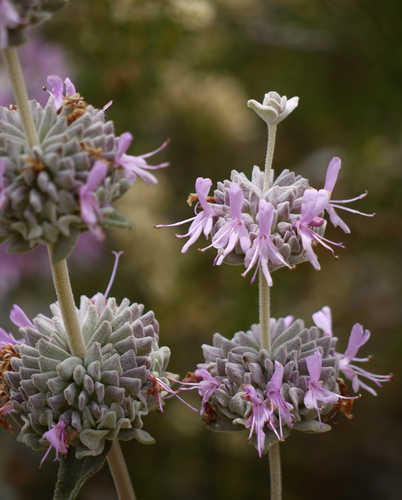
purple sage
Salvia leucophylla
A fragrant icon of the California coast, Purple Sage transforms dry hillsides into a shimmering silver landscape filled with lavender blooms and buzzing wildlife.
Quick Identification
Size
3-5 feet (0.9-1.5 m) tall and often 5-8 feet (1.5-2.4 m) wide
Colors
Silvery-gray to dusty-white foliage; flowers are light purple to rosy-lavender
Key Features
- Whorled flower clusters arranged in 3-5 distinct 'balls' along the stem
- Aromatic silvery-gray lance-shaped leaves
- Square stems typical of the mint family
- Drought-deciduous, shrinking or shedding leaves in summer
When You’ll See Them
Behavior
Purple Sage is a cornerstone species of the California coastal sage scrub community. Unlike many garden plants, it follows the rhythm of the Mediterranean climate, exploding into a silver-and-purple spectacle during the spring and early summer. It is a 'pioneer' species, often one of the first to stabilize dry slopes and provide a foundation for a healthy backyard ecosystem. Its most notable 'behavior' is its seasonal leaf dimorphism, where it produces large leaves in the wet winter and smaller, hairier leaves in the summer to survive intense heat.
For the backyard observer, Purple Sage acts as a primary nectar station. It is a high-traffic area for pollinators, particularly large native bees and hummingbirds who are attracted to the tubular shape of its blossoms. It also serves as a protective nursery; the dense, sprawling branches offer low-to-the-ground cover for quails, wrens, and lizards, making it a focal point for wildlife activity throughout the year.
EverydayEarth exclusive
Camera Tips
When targeting Purple Sage with an AI-powered camera, placement is everything. Don't just point the camera at the bush; aim it at the 'whorls' (the spherical flower clusters). This is where the action happens. Position your camera on a tripod or mount at a height of about 3 to 4 feet, angled slightly downward to capture both the top of the flower spikes and the interior branches. This setup is perfect for catching hummingbirds mid-hover or the frantic activity of Carpenter Bees. Since the silvery leaves reflect a lot of light, try to position the camera so the sun is behind it, or use a polarizing filter to prevent the bright foliage from blowing out the exposure.
To capture the more elusive 'ground' visitors like California Quail or lizards, set a second camera low—about 6 inches off the ground—aimed at the base of the shrub. Purple Sage provides excellent thermal cover, and you will often catch wildlife resting in the shade beneath its canopy during the hottest part of the day. If your AI camera allows for 'zone' triggers, set a zone specifically around the most active flower spikes to avoid 'false triggers' caused by the branches swaying in the wind, which is common with this species' light, flexible stems.
For the best visual results, focus on the 'Golden Hour'—the hour after sunrise and before sunset. The low-angle light makes the silvery-gray leaves of the Purple Sage glow with an ethereal quality, creating a stunning backdrop for any wildlife that visits. If you are using a trail camera with a time-lapse feature, try a 30-day sequence during the spring bloom. You can watch the flower spikes elongate and 'pop' in high speed, which provides a fascinating look at the plant's life cycle that most people never see.
Similar Species
Species that look similar or are commonly confused with purple sage.
White Sage
White sage has much longer, arching flower stalks and leaves that are almost pure white, with flowers spaced further apart.
Black Sage
Black sage has dark green, sticky foliage and much smaller, tighter flower clusters that turn dark brown or 'black' when they dry out.
Cleveland Sage
Cleveland sage has darker purple flowers and a much more intense, 'musky' fragrance, with greener, more wrinkled leaves.
Frequently Asked Questions
Record purple sage at your habitat
Connect a camera to start building your own species record — AI identifies every visitor automatically.