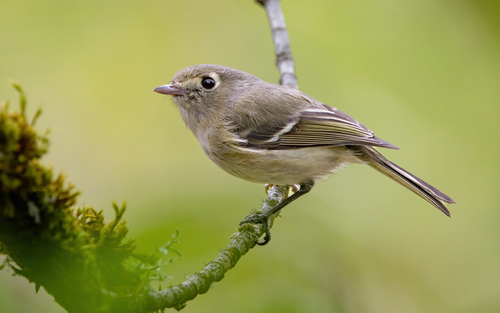
Hutton's Vireo
Vireo huttoni
The Hutton's Vireo is a master of disguise, blending perfectly into the oak and evergreen canopies of the West. Often mistaken for a kinglet, this stout little songbird rewards the patient observer with its steady, methodical presence.
Quick Identification
Size
Length: 12-13 cm (4.7-5.1 in); Wingspan: approx 20 cm (7.9 in); Weight: 10-15 g (0.35-0.53 oz)
Colors
Drab olive-green or olive-gray upperparts, pale yellowish to off-white underparts, and two white wing bars. No significant difference between males and females.
Key Features
- Thick, bluish-grey legs and a stout, slightly hooked bill
- Broken white eye-ring with a noticeable gap above the eye
- Two pale wing bars on dark wings
- Slow, deliberate movements compared to frantic kinglets
When You’ll See Them
Geographic range
Where Does the Hutton's Vireo Live?
Hutton's Vireos are native to the western regions of North America, flourishing along the Pacific Coast from southwestern Canada through the United States. Their range continues south into the interior highlands and coastal mountains of Mexico, reaching as far as the high-altitude forests of Guatemala. While they are primarily permanent residents throughout their range, some northern populations may exhibit short-distance altitudinal migration during harsh winters.
Basemap © OpenStreetMap contributors
Behavior
Hutton's Vireos are known for their patient and methodical approach to life in the canopy. Unlike the hyperactive kinglets they mimic, these vireos move at a measured pace, carefully scanning the undersides of leaves for insects. They are relatively sedentary birds, often spending their entire lives within a small territory, which makes them a reliable find for backyard observers once established.
While they are mostly solitary or found in pairs during the breeding season, they may join mixed-species foraging flocks in the winter. They are not particularly shy around humans but their cryptic coloring and tendency to stay in thick foliage can make them difficult to spot without the help of a motion-activated camera. Their song is a simple, repetitive two-part whistle that often gives away their location before they are seen.
EverydayEarth exclusive
Camera Tips
To capture high-quality footage of a Hutton's Vireo, placement is everything. Since these birds are foliage-gleaners, aim your camera at mid-story branches of oak or Douglas-fir trees. They are particularly attracted to water sources in drier climates, so positioning a camera near a bird bath or a hanging dripper is one of the most effective ways to bring them into clear view. Ensure the camera is at eye-level with the bird bath (about 3 to 5 feet off the ground) to capture the detail of their 'broken' eye-ring.
Because Hutton's Vireos move more slowly than other songbirds, you have a better chance of getting a sharp image. Set your camera's trigger speed to its fastest setting but keep the video duration at at least 15-20 seconds; this allows you to observe their characteristic 'slow-motion' foraging behavior. If your camera has a macro-focusing mode or a close-up lens attachment, use it near a feeder filled with suet or mealworms, as they will occasionally visit these during colder months.
Lighting is a challenge in the dense forests they prefer. Try to position your camera so it faces north or south to avoid the harsh backlighting of the sun, which can wash out the subtle olive tones of their plumage. If you are using an AI-powered camera like those from EverydayEarth, look for 'Bird' detection settings to prioritize these small subjects over moving branches. In the winter, focus your efforts on the edges of your property where they are more likely to join mixed flocks of chickadees and bushtits.
Similar Species
Species that look similar or are commonly confused with Hutton's Vireo.
Frequently Asked Questions
Record Hutton's Vireo at your habitat
Connect a camera to start building your own species record — AI identifies every visitor automatically.