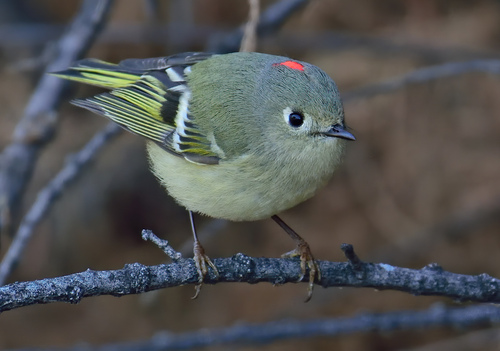
Ruby-crowned Kinglet
Corthylio calendula
A tiny ball of energy with a hidden splash of crimson, the Ruby-crowned Kinglet is a backyard favorite known for its constant wing-flicking and bold personality.
Quick Identification
Size
Length: 3.5-4.3 in (9-11 cm); Wingspan: 6.3-7.1 in (16-18 cm); Weight: 0.2-0.4 oz (5-11 g)
Colors
Olive-green upperparts with pale yellowish-white underparts; two prominent white wing bars; a bold, broken white eye-ring. Males possess a brilliant ruby-red crown patch that is usually hidden.
Key Features
- Constant, nervous wing-flicking behavior
- Bold white eye-ring giving it a 'surprised' look
- Small, thin, needle-like black bill
- Tiny size, often appearing as a round ball of feathers
- Males have a hidden red crown stripe rarely seen unless agitated
When You’ll See Them
Behavior
The Ruby-crowned Kinglet is a tiny, high-energy songbird that rarely stays still for more than a second. They are best known for their near-constant wing-flicking, a nervous habit that helps birdwatchers identify them from a distance. While foraging, they move acrobatically through the outer twigs of trees and shrubs, sometimes hovering briefly to pluck an insect from a leaf.
Despite their diminutive size, these birds are surprisingly bold. During the breeding season, males sing a remarkably loud, complex song that seems far too powerful for such a small creature. In the winter, they often join mixed-species flocks with chickadees and titmice, though they remain solitary in their personal interactions, often chasing away other kinglets from choice feeding spots.
EverydayEarth exclusive
Camera Tips
To capture the fast-moving Ruby-crowned Kinglet, place your camera at 'eye level' for the bird—roughly 3 to 6 feet off the ground. These birds spend most of their time in the mid-to-lower canopy of trees or within dense shrubbery rather than on the forest floor. Focus your lens on a specific branch or a 'landing strip' leading to a water source or feeder to catch them during their brief pauses between flickers.
Because they are so small and move with incredible speed, use a fast shutter speed or a high-frame-rate video setting if your AI camera allows. Standard motion sensors might struggle with their tiny size, so positioning the camera near a birdbath or a shallow water feature is your best bet. Kinglets are particularly attracted to moving water; adding a small dripper or a solar-powered fountain to your birdbath can be a magnet for them during their migration windows.
In terms of lures, Ruby-crowned Kinglets are primarily insect-eaters, so they are rarely interested in standard sunflower seeds. Instead, offer high-quality suet, particularly varieties containing dried mealworms or fruit. They are especially fond of 'suet crumbles' or suet smeared directly into the bark of a tree. Placing your camera near a bark-covered post or a gnarled branch with some suet hidden in the crevices will encourage them to linger long enough for the camera to trigger a high-quality capture.
Early morning is the peak window for Kinglet activity as they move quickly to replenish energy lost overnight. Set your camera's sensitivity to high during the first three hours after sunrise. During the winter months, look for them on the sunny side of evergreen trees, where they often forage for insects that are becoming active in the morning light.
Similar Species
Species that look similar or are commonly confused with Ruby-crowned Kinglet.
Frequently Asked Questions
Record Ruby-crowned Kinglet at your habitat
Connect a camera to start building your own species record — AI identifies every visitor automatically.