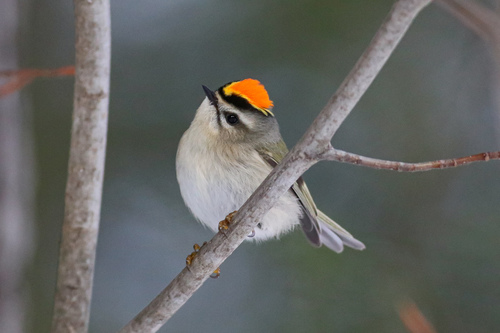
Golden-crowned Kinglet
Regulus satrapa
Meet the Golden-crowned Kinglet, a tiny bundle of energy that defies the winter chill. With its fiery crest and frantic wing-flicking, this miniature marvel is a highlight for any backyard wildlife enthusiast.
Quick Identification
Size
Length: 3.1–4.3 in (8–11 cm); Wingspan: 5.5–7.1 in (14–18 cm); Weight: 0.1–0.4 oz (4–11 g)
Colors
Olive-gray upperparts with white underparts. Distinctive black eyebrow stripe and a bright yellow crown. In males, the yellow crown has a hidden orange center that is revealed when agitated.
Key Features
- Vibrant yellow or orange crown patch bordered by black
- Constant, frantic wing-flicking while foraging
- Extremely small, rounded body with a thin, pointed bill
- Two white wing bars on dark wings
When You’ll See Them
Geographic range
Where Does the Golden-crowned Kinglet Live?
Native to the North American continent, the Golden-crowned Kinglet boasts a wide distribution spanning from the subarctic forests of Alaska and Canada down through the United States and into the mountains of Mexico and Guatemala. While northern populations are migratory, many birds remain as year-round residents in the western and northeastern U.S. states. They are most commonly spotted in the lower 48 during the winter months when northern birds move south to find more abundant foraging grounds in temperate woodlands.
Basemap © OpenStreetMap contributors
Behavior
The Golden-crowned Kinglet is a tiny, high-energy songbird that rarely stays still for more than a second. They are known for their distinctive wing-flicking behavior as they hop through dense foliage in search of tiny insects and their eggs. Despite their delicate appearance, they are remarkably hardy birds, often wintering in freezing temperatures that send most other insectivores south by huddling together in tree cavities or dense evergreens at night.
Socially, they are often found in small groups or mixed-species winter flocks alongside chickadees, nuthatches, and brown creepers. While they generally stay high in the canopy of coniferous trees during the breeding season, they become more accessible to backyard observers during migration and winter. They are surprisingly bold and may allow a quiet observer to get quite close, though their rapid movements make them a challenge to track without a camera.
EverydayEarth exclusive
Camera Tips
Capturing the Golden-crowned Kinglet on camera requires speed and strategic placement. Because they are canopy-dwellers that move rapidly, position your camera 6 to 10 feet high, angled toward the outer branches of spruce, fir, or pine trees. If you have a birdbath, this is your best chance for a close-up; kinglets are attracted to the sound of moving water, so a solar dripper or fountain can lure them into the frame of a lower-mounted camera during the drier months.
Use a high-speed trigger setting if your AI camera allows it. These birds are 'fidgety'—they flick their wings constantly—which can cause motion blur on slower shutters. Aim for a spot where sunlight filters through the branches in the morning; the natural light will help highlight the golden crown, which otherwise looks like a simple dark stripe in deep shade. Setting a fast shutter speed or high-sensitivity trigger is essential to catch their micro-movements.
While they don't typically eat standard birdseed, you can attract them during winter months with high-energy suet or peanut butter spread into the deep furrows of tree bark. Mount your camera about 3-4 feet away from a suet feeder or a 'smear' spot on a trunk. Since they are among the smallest birds in North America, ensure your camera's focal range is set correctly for close-up action to avoid blurry shots of these miniature visitors.
Similar Species
Species that look similar or are commonly confused with Golden-crowned Kinglet.
Frequently Asked Questions
Record Golden-crowned Kinglet at your habitat
Connect a camera to start building your own species record — AI identifies every visitor automatically.