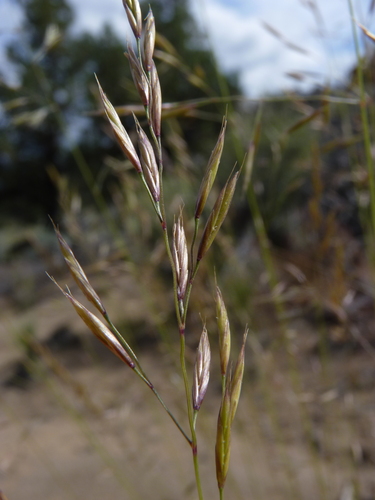
Idaho fescue
Festuca idahoensis
With its striking silvery-blue blades and elegant upright stalks, Idaho fescue is the architectural gem of the Western prairie. This hardy bunchgrass is a vital sanctuary for ground-nesting birds and a favorite snack for wandering deer.
Quick Identification
Size
Height ranges from 12 to 40 inches (30 to 100 cm) with a bunch diameter of 6 to 10 inches (15 to 25 cm)
Colors
Distinctive blue-green to silvery foliage; turns golden-tan or straw-colored when dormant or seeding
Key Features
- Densely tufted bunchgrass habit
- Fine, hair-like leaves that are tightly rolled
- Stiff, upright flower stalks (panicles) extending above the foliage
- Bluish-gray glaucous coating on stems
- Deep, fibrous root system reaching up to 15 inches
When You’ll See Them
Behavior
Idaho fescue is a perennial bunchgrass that serves as a cornerstone of the Western American landscape. Unlike spreading lawn grasses, it grows in tight, discrete clumps, leaving small spaces of bare earth or moss between plants. This 'bunch' growth habit is essential for biodiversity, as it allows ground-nesting birds to navigate through the grass while remaining hidden from aerial predators. During the spring, the plant grows rapidly, producing high-protein forage that is highly sought after by local herbivores.
As the heat of mid-summer arrives, Idaho fescue often enters a semi-dormant state to conserve water, though its deep roots allow it to remain more resilient than many other native species. It does not spread via runners (rhizomes); instead, it reproduces strictly through seeds dropped from its tall, nodding panicles. In backyard settings, it acts as a passive neighbor to wildlife, providing structural cover for insects and small mammals throughout the winter months when the dry stalks remain standing.
EverydayEarth exclusive
Camera Tips
To capture the true beauty of Idaho fescue, position your AI camera at a low 'insect-level' angle, roughly 6 to 12 inches off the ground. This perspective emphasizes the bunchgrass's architectural tufts and allows you to capture the fine details of its thread-like leaves. For the most striking shots, aim the camera toward the setting sun; the backlighting will make the fine hairs of the seed heads glow, creating a beautiful 'halo' effect that makes the plant stand out against the background.
Because Idaho fescue is a preferred forage for Mule Deer and Elk, it serves as an excellent natural lure. Place your camera about 15 feet away from a healthy patch of fescue, ensuring the field of view covers the tops of the grass. During the late spring and early summer 'green-up,' deer will return to these specific clumps daily. Set your camera to 'Burst Mode' or 'Short Video' to capture the grazing behavior, as the movement of the deer's muzzle through the blue-green blades provides excellent behavioral footage.
If you are interested in the micro-fauna that visits the grass, use a macro lens or a camera with a close focus distance. Early morning is the best time for this, as the grass often traps heavy dew. You can catch stunning images of dragonflies, grasshoppers, or spiders that use the stiff stalks as hunting platforms. For those using motion-activated cameras, be aware that Idaho fescue sways gracefully in the wind. To prevent hundreds of empty clips, set your motion sensitivity to 'Medium' and use a detection zone that focuses on the ground level where animals enter the frame rather than the swaying tops of the grass.
Similar Species
Species that look similar or are commonly confused with Idaho fescue.
Frequently Asked Questions
Record Idaho fescue at your habitat
Connect a camera to start building your own species record — AI identifies every visitor automatically.