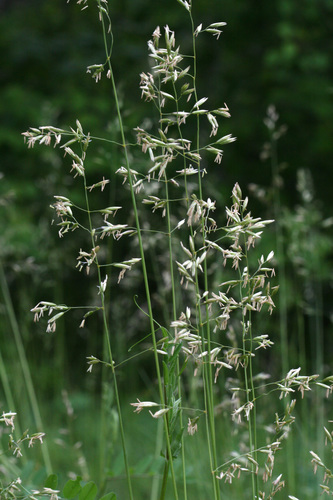
Rough Fescue
Festuca hallii
The backbone of the northern prairie, Rough Fescue is a hardy perennial bunchgrass that provides vital habitat and stunning golden vistas. Known as the 'Queen of the Prairie,' it is a symbol of a healthy and thriving wild landscape.
Quick Identification
Size
Height ranges from 20 to 85 cm (8 to 33 inches) with tufts 5 to 15 cm (2 to 6 inches) wide.
Colors
Pale yellowish-green to bluish-green during growth; matures to a golden-straw color in winter.
Key Features
- Densely tufted bunchgrass growth habit
- Rough-textured, sandpapery leaf blades
- Persistent old leaf sheaths forming a 'skirt' at the base
- Narrow, contracted seed heads (panicles) 6–15 cm long
When You’ll See Them
Behavior
Rough Fescue is a long-lived perennial bunchgrass that serves as the 'Queen of the Prairie.' Unlike many other grasses, it is a cool-season grower, meaning it begins its life cycle early in the spring as soon as the snow melts. It grows in distinct, tight clumps that can live for decades if left undisturbed. Because it is highly sensitive to heavy foot traffic or overgrazing, the presence of healthy Rough Fescue is often seen as a biological indicator of a pristine, high-quality ecosystem.
While it may seem stationary, Rough Fescue is a dynamic part of the backyard environment. It provides essential structural complexity, acting as a nursery for ground-nesting birds and a sheltered highway for small mammals and beneficial insects. In the autumn, it doesn't simply die back; it cures on the stem, retaining its nutritional value and upright structure through the winter, offering both beauty and a vital food source for wildlife during the leanest months of the year.
EverydayEarth exclusive
Camera Tips
Capturing the quiet majesty of Rough Fescue requires a shift in how you think about wildlife photography. Since the grass won't run away, focus on composition and lighting. Use a low-profile ground mount for your trail camera, positioning it just 6–12 inches off the ground. Angle the lens slightly upward to emphasize the height of the seed heads against the sky. This perspective makes the bunchgrass look like a towering forest for the small insects and rodents that inhabit its base.
The 'golden hours'—the first and last hour of sunlight—are your best friends. During these times, the low sun hits the edges of the rough leaf blades and the delicate panicles, creating a 'rim light' effect that makes the grass appear to glow. If your camera allows for manual shutter speed settings, a fast shutter will freeze the grass in a crisp, sharp image, while a slower shutter speed on a windy day can create a beautiful, painterly motion blur that captures the 'waves of grain' effect the prairie is famous for.
Time-lapse mode is the secret weapon for this species. Set your camera to take one photo every hour for a full week during the early summer. When played back, you’ll see the dramatic 'reach' of the fescue as it shoots up its flowering stalks. Additionally, because Rough Fescue is a magnet for other wildlife, place your camera nearby to catch birds like the Vesper Sparrow or Meadowlark which frequently use the stiff stalks as song perches or nesting cover.
Don't stop recording in the winter. Rough Fescue is one of the few grasses that stays upright under light snow. The contrast of the golden-brown stalks against a white background provides stunning high-contrast imagery. Look for days with heavy frost; the 'rough' texture of the blades provides the perfect surface for ice crystals to latch onto, turning your backyard grass into a shimmering crystal sculpture for your camera to document.
Similar Species
Species that look similar or are commonly confused with Rough Fescue.
Frequently Asked Questions
Record Rough Fescue at your habitat
Connect a camera to start building your own species record — AI identifies every visitor automatically.