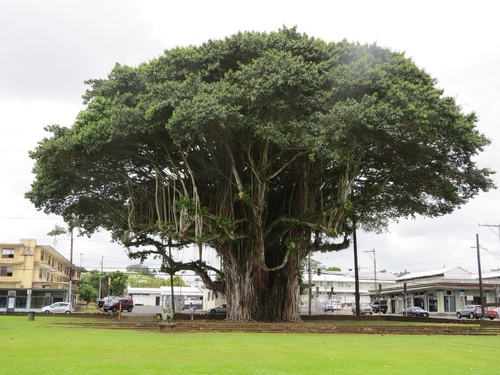
Indian banyan
Ficus benghalensis
The legendary Indian banyan is more than just a tree—it is a living ecosystem that spreads across the landscape with a 'walking' forest of roots. Known as a sacred symbol of eternal life, it serves as a bustling hub for the most vibrant wildlife in the garden.
Quick Identification
Size
Height up to 20-30 meters (65-100 feet); canopy coverage can exceed 2,000 square meters (0.5 acres).
Colors
Smooth gray bark; deep green glossy leaves with pale veins; figs ripen from green to a vibrant scarlet red.
Key Features
- Vast network of hanging aerial prop roots that thicken into woody trunks
- Large, leathery, elliptical leaves up to 8 inches long
- Small, round, stalkless figs that grow in pairs
- Massive, spreading canopy that provides deep shade
When You’ll See Them
Behavior
The Indian banyan is a master of spatial expansion, famously known as a 'strangler fig.' It typically begins life as an epiphyte, with seeds dropped by birds into the crevices of a host tree. From there, it sends down rope-like aerial roots that eventually reach the soil, thicken, and become functional trunks. Over decades, a single tree can appear as a miniature forest, with the parent trunk often rotting away to leave a hollow center surrounded by its own 'offspring' roots.
This tree functions as an ecological cornerstone, or 'keystone species.' Its ability to produce massive quantities of figs—sometimes out of sync with other fruiting trees—makes it a vital food source for an incredible diversity of wildlife. It doesn't just sit there; it hosts an entire community of insects, birds, and mammals, acting as a vertical neighborhood where different species occupy different levels of the canopy and root system.
EverydayEarth exclusive
Camera Tips
When setting up a camera to observe an Indian banyan, remember that you aren't just filming a tree—you are filming a high-traffic wildlife intersection. To capture the widest variety of species, mount your camera 6 to 10 feet high on one of the sturdy aerial prop roots, angled slightly downward toward a cluster of ripening figs. These fruiting branches are the 'stages' where birds, monkeys, and squirrels congregate, providing the best opportunities for high-action triggers.
Lighting can be a challenge under the banyan’s dense canopy, which creates deep, dark shadows even at midday. If your camera allows for manual exposure settings, increase the ISO or exposure compensation slightly to compensate for the shade. For nocturnal visitors like fruit bats or civets, ensure your camera has a high-quality 'no-glow' infrared flash. These animals are often skittish and will avoid the area if they detect the faint red glow of standard IR LEDs.
If you are interested in the tree’s botanical movement, use a time-lapse mode. Set your camera to take one photo every 24 hours from a fixed distance to watch the aerial roots slowly descend toward the earth—a process that is mesmerizing when sped up. Because the tree produces sticky white latex sap, avoid mounting the camera directly against freshly broken branches or 'bleeding' bark, as the resin can smudge your lens or damage the casing. Always use a security box or strap, as the curious macaques and birds that frequent these trees may try to investigate your gear.
Similar Species
Species that look similar or are commonly confused with Indian banyan.
Frequently Asked Questions
Record Indian banyan at your habitat
Connect a camera to start building your own species record — AI identifies every visitor automatically.