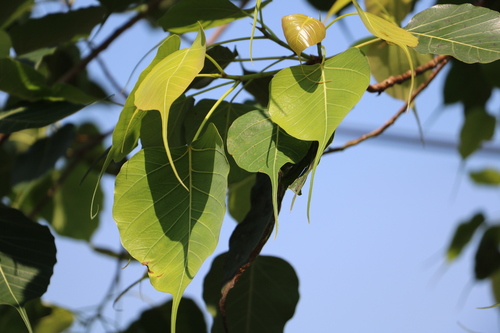
Sacred fig
Ficus religiosa
The Sacred fig, also known as the Bodhi tree, is a majestic giant of the plant kingdom, famous for its heart-shaped leaves and deep spiritual significance. A true 'Tree of Life,' it serves as a bustling hub for hundreds of bird and mammal species.
Quick Identification
Size
A large tree reaching heights of 20–30 meters (65–98 feet) with a trunk diameter of up to 3 meters (10 feet).
Colors
Glossy dark green leaves with pale veins; smooth, light grey bark; small figs that turn from green to purple-black when ripe.
Key Features
- Distinctive heart-shaped leaves with a long, slender 'drip-tip' tail
- Smooth, ash-grey bark that often peels in older specimens
- Small, stalkless figs found in pairs along the twigs
- Wide-spreading canopy that often extends further than the tree's height
When You’ll See Them
Behavior
The Sacred fig is a long-lived deciduous or semi-evergreen tree known for its unique growth habit. While it often starts its life in the ground, it can also begin as an epiphyte, growing in the crevices of other trees or even man-made structures like walls and buildings. It is a keystone species in its native ecosystem, providing a massive amount of food and shelter for a variety of urban and forest wildlife. Unlike some other fig species, it rarely produces the massive hanging aerial roots seen in Banyan trees, though it may develop some buttressing at the base.
This tree shares a fascinating symbiotic relationship with the fig wasp (Blastophaga quadriceps). The tree relies entirely on this specific wasp for pollination, while the wasp uses the figs as a nursery for its larvae. Culturally, the Sacred fig is deeply intertwined with human history, often found at the center of villages or near temples, where its vast shade serves as a gathering point for meditation and community life. In a backyard setting, it acts as a central hub for biodiversity, attracting everything from squirrels and fruit bats to exotic birds.
EverydayEarth exclusive
Camera Tips
When monitoring a Sacred fig with a trail camera, the goal is usually to capture the incredible diversity of visitors rather than the tree itself. Because these trees can be quite large, placement is everything. If you are targeting birds like barbets, parakeets, or hornbills, mount your camera on a nearby structure or a high branch of a neighboring tree, aiming at the fruiting clusters. Use a high-speed trigger and burst mode (3-5 photos), as bird activity during a 'figging' event is incredibly fast-paced and chaotic.
For nocturnal visitors like fruit bats or civets, position the camera to face the most heavily laden fruit branches. Ensure your infrared flash is set to 'Medium' or 'Low' to avoid overexposing the shiny, waxy surface of the leaves, which can reflect light and blow out the image. If the tree is older with large buttressed roots, place a camera near the ground at a 45-degree angle to capture ground-dwelling mammals or reptiles that come to forage on fallen fruit. This 'ground-level cleanup' is a great way to see species you won't see in the canopy.
Because the Sacred fig's leaves have long 'drip-tips' that move easily in the slightest breeze, you may experience many 'false triggers.' To combat this, increase the sensitivity threshold on your camera or use a zone-based trigger if your AI camera supports it. If your camera has a time-lapse function, consider setting it to take one photo every hour. Over several months, this will beautifully document the tree's seasonal changes, from the bronze-tinted new leaves of spring to the heavy purple harvest of summer.
Finally, don't ignore the trunk. Many species of lizards and insects call the bark home. Mounting a camera vertically about five feet up the trunk, facing a prominent branch junction, can yield amazing close-ups of urban wildlife using the tree as a highway. If you are in a backyard setting, make sure the camera is shaded by the canopy itself to avoid lens flare during the peak daylight hours when the sun is directly overhead.
Similar Species
Species that look similar or are commonly confused with Sacred fig.
Frequently Asked Questions
Record Sacred fig at your habitat
Connect a camera to start building your own species record — AI identifies every visitor automatically.