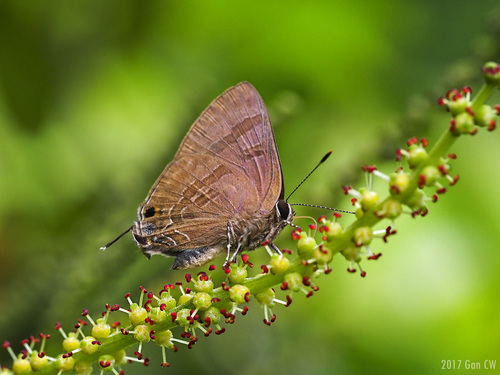
Indigo Flash
Rapala varuna
The Indigo Flash is a living jewel of the backyard, known for its sudden bursts of sapphire-blue color and its clever 'false head' trickery. A favorite of macro-photography enthusiasts, this swift-moving hairstreak brings a touch of tropical brilliance to any garden.
Quick Identification
Size
Wingspan of 28–34 mm (1.1–1.3 inches)
Colors
Males are a deep, iridescent indigo-blue on the upper side; females are brownish-grey. Both have a greyish-brown underside with a dark transverse band and an orange-ringed black spot near the tail.
Key Features
- Slender 'hairstreak' tail on the hindwing
- Deep indigo-blue metallic sheen on male upper wings
- Distinctive dark brown transverse band on the wing underside
- Small orange and black eyespot near the tail base
When You’ll See Them
Behavior
The Indigo Flash is a remarkably fast and erratic flyer, often seen darting between sunlit patches in the garden. It is a highly territorial species; males are known to pick a 'perch' on a prominent leaf and will aggressively fly out to investigate or chase away any other butterflies that enter their airspace, usually returning to the exact same leaf moments later.
When resting, they almost always sit with their wings closed, showing off their cryptic underside which mimics a dead leaf. However, they frequently perform a 'wing-grinding' motion where the hindwings slide against each other. This movement makes the tails look like antennae and the eyespots look like a head, a clever trick designed to fool birds into attacking the wrong end of the butterfly.
EverydayEarth exclusive
Camera Tips
To capture the Indigo Flash, you need to think like a territorial butterfly. Look for 'perching stones' or specific sun-drenched leaves at the edge of your garden path about 3 to 5 feet off the ground. Once you see one land, it will likely return to that spot daily. Position your AI camera on a tripod or mount just 12 to 24 inches from this perch. Because they are small, a macro lens or a close-focus setting is vital to see the intricate details of the wing scales.
Lighting is the most critical factor for this species. The 'indigo' color is structural, meaning it only appears when light hits the wings at a specific angle. Set your camera facing North or South to ensure the midday sun provides side-lighting, which is best for highlighting the metallic blue shimmer. If your camera has a 'Pro' or manual mode, increase the shutter speed to at least 1/2000 of a second to freeze their rapid wing beats during takeoff.
If you want to lure them into a specific frame, plant nectar-rich 'landing pads' like Lantana or Ixora. These butterflies are also occasionally attracted to overripe fruit or moisture on the ground (puddling). Placing a shallow 'puddling station'—a dish of damp sand with a pinch of sea salt—near your camera's focal point can encourage them to stay still long enough for a perfect high-resolution capture. Ensure your motion sensitivity is set to its highest level, as their small size may not always trigger standard sensors.
Similar Species
Species that look similar or are commonly confused with Indigo Flash.
Frequently Asked Questions
Record Indigo Flash at your habitat
Connect a camera to start building your own species record — AI identifies every visitor automatically.