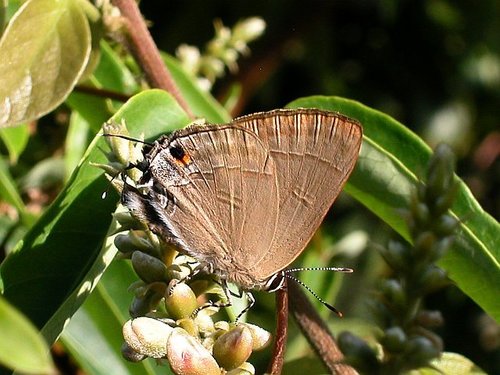
Slate Flash
Rapala manea
A metallic marvel of the garden, the Slate Flash is a tiny powerhouse of speed and color. Look for its shimmering blue wings and clever 'false head' trickery among sun-drenched leaves.
Quick Identification
Size
Wingspan of 28–32 mm (1.1–1.3 inches)
Colors
Males have a slate-blue upperside with a violet sheen; females are a duller brownish-gray. The underside of both sexes is a distinctive purplish-brown or grayish-brown with a dark transverse band.
Key Features
- Slender filamentous tails on the hindwings
- Metallic slate-blue upperside sheen (males)
- Dark, straight transverse line across the underside of both wings
- Small orange-ringed black eyespot near the tail
When You’ll See Them
Behavior
The Slate Flash is a high-energy butterfly known for its rapid, erratic flight. Males are intensely territorial, often selecting a specific 'sentry' leaf at the edge of a clearing or atop a garden shrub. From this perch, they will dart out to investigate or chase away any passing insect—including much larger butterflies—before returning to the exact same spot moments later.
When resting, they often rub their hindwings together in a vertical motion. This behavior causes their delicate tails to wiggle, which mimics the movement of antennae. This 'false head' strategy is designed to trick birds and other predators into attacking the expendable wing edges rather than the butterfly's actual head. They are relatively bold and will allow a close approach if they are focused on sun-basking or nectar-feeding.
EverydayEarth exclusive
Camera Tips
To capture high-quality images of the Slate Flash, you need to exploit their territorial nature. Identify a 'sentry perch'—usually a sunlit leaf at head height or higher—where you see a butterfly returning repeatedly. Set your camera on a tripod or mount focused specifically on this leaf. Because these butterflies are small, a macro lens or a camera with a close-focusing distance of 12-20 inches is essential for the AI to trigger effectively on the motion.
Lighting is your best friend with this species. The 'flash' of blue that gives them their name is only visible when the sun hits the upperside of their wings at specific angles. Position your camera with the sun at your back, pointing toward the butterfly’s favorite basking spot. If using an AI-powered camera, set it to 'Insect' mode with a high shutter speed (at least 1/1000s) to freeze their rapid wing movements. Using a burst mode of 5-10 frames will increase your chances of catching the wings open during takeoff.
If you want to lure them to a specific spot for your camera, plant flowering Lantana or Ixora nearby. These are favorite nectar sources that will keep the butterfly stationary for several seconds, allowing the camera's autofocus to lock on. Additionally, male Slate Flashes are known to engage in 'puddling.' Placing a shallow dish with damp sand and a pinch of salt or a piece of overripe fruit near your camera station can entice them to ground level for unique low-angle shots.
Similar Species
Species that look similar or are commonly confused with Slate Flash.
Frequently Asked Questions
Record Slate Flash at your habitat
Connect a camera to start building your own species record — AI identifies every visitor automatically.