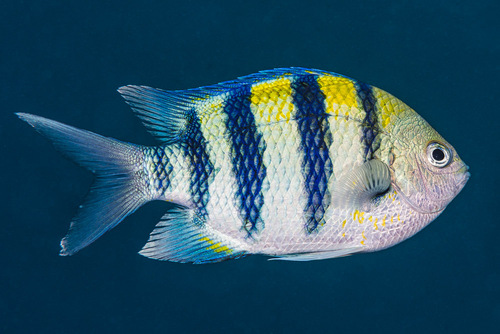
Indo-Pacific Sergeant Major
Abudefduf vaigiensis
The Indo-Pacific Sergeant Major is a bold, striped sentinel of the reef, known for its fearless personality and striking vertical bands. Whether schooling in the thousands or guarding a nest, this vibrant damselfish is an icon of tropical coastal waters.
Quick Identification
Size
Typically reaches 15 to 20 cm (6 to 8 inches) in length
Colors
Silvery-white body with a bright yellow-green wash on the upper back; five distinct vertical black bars along the sides; males turn bluish-purple when guarding eggs
Key Features
- Five prominent vertical black bands
- Bright yellow coloration on the dorsal surface
- Deeply forked tail fin
- Oval-shaped and laterally compressed body
When You’ll See Them
Geographic range
Where Does the Indo-Pacific Sergeant Major Live?
The Indo-Pacific Sergeant Major is widely distributed across the tropical and subtropical waters of the Indo-Pacific region. Its native range extends from the Red Sea and the eastern coast of Africa all the way to the Hawaiian Islands and the Tuamotu Archipelago, reaching as far north as southern Japan and as far south as Australia. In recent years, it has become an adventurous traveler, migrating through the Suez Canal to establish a significant presence in the eastern Mediterranean Sea.
Basemap © OpenStreetMap contributors
Behavior
The Indo-Pacific Sergeant Major is a highly social and energetic damselfish, often found in massive, swirling schools that hover above coral reefs or around man-made structures. They are renowned for their curiosity and lack of fear toward humans, frequently approaching snorkelers and divers in search of food or simply to investigate. Their social structure is fluid outside of the breeding season, but they become highly organized when feeding on plankton in the water column.
During the spawning season, the behavior of the males shifts dramatically. Each male stakes out a territory on a flat rock or coral surface, cleaning it meticulously to attract a female. Once the eggs are laid, the male becomes an aggressive guardian, chasing away predators many times his size and even nipping at the fins of passing fish or the hands of unwary swimmers. During this period, the male's typical silver and yellow coloration darkens to a deep, moody blue or purple.
EverydayEarth exclusive
Camera Tips
Capturing the Indo-Pacific Sergeant Major requires an underwater camera setup, such as a GoPro or a specialized AI reef camera, positioned in shallow, well-lit water. Because these fish are naturally attracted to structure, the best strategy is to mount your camera directly to a pier piling or use a weighted tripod placed near a rocky outcrop. They are highly active in the surge zone, so ensure your mount is heavy enough to remain steady during tidal shifts.
Lighting is the most critical factor for clear identification. Aim to film between 10 AM and 2 PM when the sun is directly overhead; this illuminates their yellow dorsal patches and makes the five black stripes pop for the AI detection software. If you are deploying a camera in a backyard tide pool or off a private dock, placing a small piece of mesh filled with crushed shells or sea grapes nearby can create a natural foraging spot that keeps them in the frame without disrupting their natural diet.
For those looking to capture unique breeding behaviors, look for 'nesting' sites—flat, dark rocks that appear to have a purple velvety coating (which are actually the eggs). Position your camera about 2 feet away from these spots. Because the males are so territorial, they will likely swim directly up to the lens, providing incredible close-up footage. Set your camera to 60fps to handle their quick, darting movements and use a wide-angle lens to capture the scale of the schools swimming overhead.
Similar Species
Species that look similar or are commonly confused with Indo-Pacific Sergeant Major.
Frequently Asked Questions
Record Indo-Pacific Sergeant Major at your habitat
Connect a camera to start building your own species record — AI identifies every visitor automatically.