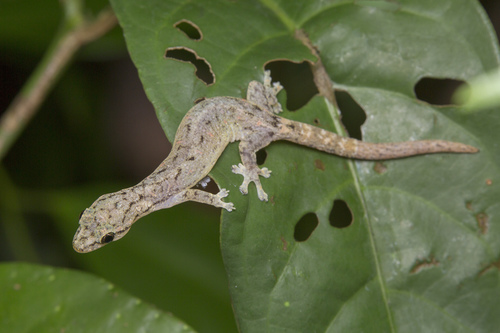
Indo-Pacific Slender Gecko
Hemiphyllodactylus typus
A pint-sized pioneer of the reptile world, the Indo-Pacific Slender Gecko is a master of camouflage and a silent guardian of your garden. Known for its 'self-cloning' abilities and secretive nature, this tiny gecko is a fascinating find for any backyard explorer.
Quick Identification
Size
Total length of 7–8 cm (2.8–3.1 inches); weight is approximately 1–3 grams (0.04–0.1 oz).
Colors
Variable shades of tan, grey, or brownish-pink; often features dark speckling or a row of faint chevrons along the spine.
Key Features
- Extremely slender, almost worm-like body shape
- Rudimentary or missing claw on the innermost toes
- Large, lidless eyes with vertical pupils
- Granular scales without prominent bumps or tubercles
When You’ll See Them
Geographic range
Where Does the Indo-Pacific Slender Gecko Live?
Originally native to South and Southeast Asia, the Indo-Pacific Slender Gecko has a core range spanning from India and Sri Lanka through Thailand, Malaysia, and the Philippines, all the way to Indonesia. It has proven to be an exceptional traveler, establishing introduced populations across various Pacific islands including Hawaii, as well as parts of Japan and even the Mascarene Islands. It thrives in humid, tropical environments but has adapted perfectly to human-modified landscapes like orchards and suburban neighborhoods.
Basemap © OpenStreetMap contributors
Behavior
The Indo-Pacific Slender Gecko is a secretive, nocturnal reptile that spends most of its life hidden in the shadows. Unlike the more aggressive and vocal House Geckos often seen near porch lights, this species is much more reserved. It prefers to navigate the narrowest crevices of tree bark or building walls, using its thin frame to access spots where larger predators cannot reach. It is a slow, methodical climber that relies on stealth rather than speed.
One of the most remarkable biological traits of many Indo-Pacific Slender Gecko populations is parthenogenesis. In several regions, the population consists entirely of females that produce fertile eggs without the need for mating. This 'self-cloning' ability allows a single individual to potentially start a new colony, which explains why they have been so successful at colonizing remote islands throughout the Pacific and Indian Oceans.
EverydayEarth exclusive
Camera Tips
Capturing the Indo-Pacific Slender Gecko on your backyard camera requires a targeted approach because of their small size and preference for vertical surfaces. Position your AI-powered camera about 3 to 5 feet high on a tree trunk, a wooden fence, or a brick wall. These geckos love texture, so a wall with some climbing ivy or rough bark is an ideal 'highway' for them to traverse. Since they are so small, try to set the camera focus for a closer range (macro mode) if your device supports it, to ensure the AI can clearly see the diagnostic toe pads and skin patterns.
Lighting is your best friend when hunting for these geckos. While they are nocturnal, they are frequently drawn to the peripheries of porch lights or garden lanterns where small insects congregate. Angle your camera so it captures the area just outside the brightest light; the geckos often wait in the 'transition zone' between light and dark to ambush their prey. If you are using a trail camera with an infrared flash, ensure it is set to a high sensitivity to trigger on their relatively small heat signature and movement.
To increase your sighting frequency, look for 'gecko hotspots'—places where siding meets the house frame or where loose bark creates a natural gap. These are their daytime retreats. Placing a camera near these exit points at dusk will often catch them as they emerge for the night. While they don't respond to traditional baits like mammals do, keeping a small outdoor water feature or a compost bin nearby can increase the local insect population, which in turn acts as a natural magnet for these slender hunters. Rain also plays a role; you'll often see increased activity on warm, humid nights just after a light shower.
Similar Species
Species that look similar or are commonly confused with Indo-Pacific Slender Gecko.
Frequently Asked Questions
Record Indo-Pacific Slender Gecko at your habitat
Connect a camera to start building your own species record — AI identifies every visitor automatically.