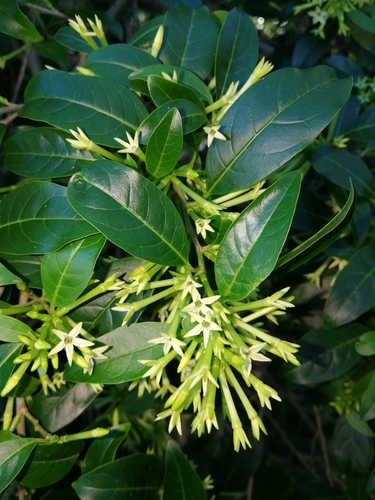
inkberry
Cestrum laevigatum
The Inkberry is a shimmering evergreen shrub that transforms your backyard into a sensory hotspot, vibrating with life from its nectar-rich night blooms to its dark, jewel-like berries.
Quick Identification
Size
A woody shrub or small tree reaching 6.5–16 feet (2–5 meters) in height with a spread of 3–6 feet (1–2 meters).
Colors
Glossy bright green leaves; pale greenish-yellow tubular flowers; berries ripen from green to a deep, inky purple-black.
Key Features
- Lance-shaped, alternate leaves with a smooth (laevigatum) texture
- Clusters of narrow, tubular greenish-yellow flowers
- Small oval berries that turn dark purple/black when ripe
- Intense, sweet fragrance emitted primarily at night
When You’ll See Them
Behavior
Inkberry is an evergreen shrub known for its vigorous growth and its role as a hub for local biodiversity. While it appears stationary, it is highly active on a chemical and biological level. During the day, the plant focuses on photosynthesis and fruit production, but as dusk falls, it undergoes a dramatic transition. The tubular flowers open fully and release a potent, sweet perfume designed to signal nocturnal pollinators from great distances.
In the backyard ecosystem, Inkberry serves as a vital food source and shelter. Its dense branching structure provides excellent nesting sites for small birds, while its year-round foliage offers protection from predators. However, gardeners should be aware that all parts of the plant, especially the unripe berries, contain hepatotoxic glycosides, making it toxic to livestock and potentially harmful if ingested by pets or humans.
EverydayEarth exclusive
Camera Tips
Capturing the life surrounding an Inkberry bush requires a strategy that accounts for both the daytime fruit-eaters and the nighttime nectar-seekers. To catch birds like thrushes or waxwings feeding on the berries, position your camera approximately 3 to 5 feet away from a ripe cluster. Aim the lens slightly downward from a height of 4 feet to capture the birds as they perch on the slender branches. Use a high shutter speed if your camera allows, as bird movements are rapid and jittery.
For the most magical footage, set your camera to its night-vision or infrared mode. Because Inkberry (Cestrum laevigatum) is a magnet for Hawkmoths and other large nocturnal pollinators, you should focus your camera on a cluster of open flowers. Place the camera on a tripod or stable mount to avoid wind-induced false triggers, and set the sensitivity to 'High' to detect the fast-moving wings of visiting moths. If your camera has a time-lapse feature, a 24-hour cycle can beautifully demonstrate how the flowers transition between day and night.
Since this plant is often used as a hedge, placing a camera at the base of the shrub looking upward can reveal the 'hidden' world of ground-dwelling wildlife that uses the low-hanging branches for cover. Look for small mammals or reptiles navigating the leaf litter. In suburban settings, keep the camera active during the early morning hours (just after sunrise) when the dew is still on the berries, as the light at this time creates the most professional-looking, high-contrast images of the fruit and visiting wildlife.
Similar Species
Species that look similar or are commonly confused with inkberry.
Frequently Asked Questions
Record inkberry at your habitat
Connect a camera to start building your own species record — AI identifies every visitor automatically.