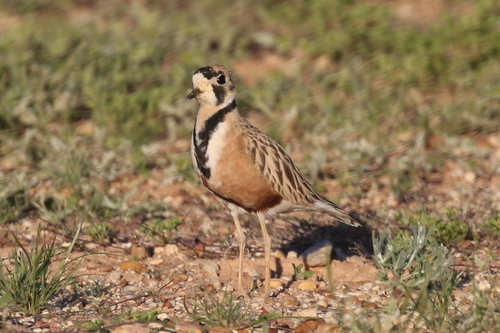
Inland Dotterel
Peltohyas australis
A ghost of the Australian gibber plains, the Inland Dotterel is a striking desert specialist that trades wetlands for the arid interior. With its bold black chest-band and nocturnal habits, it is one of the outback's most elusive and fascinating avian residents.
Quick Identification
Size
Length: 19–23 cm (7.5–9 inches); Weight: 60–100 g (2.1–3.5 oz)
Colors
Sandy-buff upperparts with dark mottling; creamy-white belly; distinctive black Y-shaped band across the chest and neck; black eye-mask through the face.
Key Features
- Prominent black Y-shaped breast band
- Sandy-brown camouflaged plumage matching desert soil
- Bold black 'mask' running through the eyes and crown
- Large, dark eyes specialized for nocturnal vision
When You’ll See Them
Geographic range
Where Does the Inland Dotterel Live?
This unique wader is endemic to the vast, arid interior of Australia. Its core range spans the desert regions of South Australia, New South Wales, Queensland, and Western Australia, particularly throughout the Lake Eyre basin. While they are permanent residents of the Australian continent, their presence in specific districts is highly nomadic, as they shift across the landscape in response to erratic rainfall and food availability.
Basemap © OpenStreetMap contributors
Behavior
The Inland Dotterel is a master of desert survival, often spending the scorching daylight hours 'loafing' in the shade of low shrubs or within the cracks of dry claypans. They are social birds, usually found in loose flocks of 10 to 20 individuals, though larger groups may congregate near water sources during extreme dry spells. Unlike many other shorebirds, they have adapted to a completely terrestrial life in the Australian interior.
As the sun sets, these birds become much more active and vocal. They move onto open ground and even remote dirt roads to forage for food, using their large eyes to spot movement in the dark. While they are generally shy and will run or fly short distances if approached, they are remarkably well-camouflaged; a bird standing still on a stony gibber plain is almost invisible to the naked eye until it moves.
EverydayEarth exclusive
Camera Tips
Capturing the Inland Dotterel on camera requires a strategy focused on their ground-dwelling habits. Since these birds spend almost all of their time on the earth, place your AI-powered camera at a very low height—no more than 10 to 20 centimeters off the ground. Aiming the lens across a flat, open area like a claypan or a clearing between saltbush will yield the best results. A wide-angle field of view is ideal, as these birds often move in loose, scattered groups rather than single files.
Because they are primarily nocturnal foragers, high-quality infrared or 'no-glow' flash settings are essential to capture clear images without startling the birds. They are famously attracted to remote dirt tracks and roads at night, likely because the open surface makes insects easier to spot. Setting up a camera along a quiet station track or a dry creek bed can be a highly effective way to intercept a foraging flock.
During the day, position your camera near the base of low-lying shrubs or shade-providing vegetation. In the heat of the afternoon, the birds will huddle in these shaded patches to thermoregulate. While typical bird lures like birdbaths are less effective for this arid specialist, they are more likely to visit permanent bores or cattle troughs during periods of extreme drought. Look for their distinctive three-toed tracks in soft silt or sand to identify the best placement spots.
Similar Species
Species that look similar or are commonly confused with Inland Dotterel.
Oriental Plover
The Oriental Plover lacks the bold black Y-shaped chest band and is typically found in more grassy habitats during the summer months.
Black-fronted Dotterel
Much smaller with a bright red eye-ring and a distinct V-shaped black chest band, and it is strictly tied to freshwater margins rather than dry plains.
Frequently Asked Questions
Record Inland Dotterel at your habitat
Connect a camera to start building your own species record — AI identifies every visitor automatically.