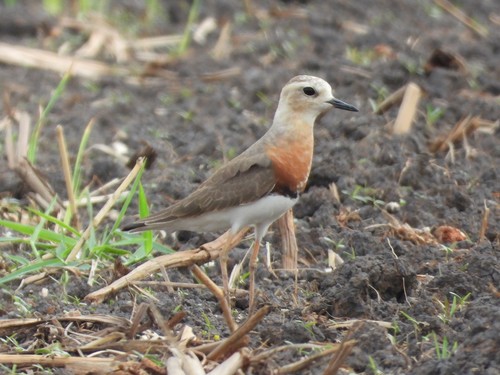
Oriental Plover
Anarhynchus veredus
Meet the elegant globetrotter of the grasslands. With its slender legs and striking breast bands, the Oriental Plover brings a touch of the Mongolian wilderness to the open plains of the Southern Hemisphere.
Quick Identification
Size
Length: 21–25 cm (8.3–9.8 in); Wingspan: 46–53 cm (18–21 in); Weight: 75–110 g (2.6–3.9 oz)
Colors
Upperparts are sandy grayish-brown; breeding males feature a white face and throat with a wide chestnut breast band bordered by a thin black line. Females and non-breeding birds have paler, more uniform buff-brown underparts.
Key Features
- Slender, long-legged silhouette with an upright posture
- Distinct white forehead and throat in breeding plumage
- Broad chestnut breast band with a black lower edge (males)
- Large, dark eyes suited for low-light foraging
When You’ll See Them
Behavior
The Oriental Plover is a remarkable long-distance traveler, known for its elegant, upright stance and swift terrestrial movements. Unlike many other shorebirds that stick strictly to the water's edge, these plovers are often found on dry, open plains, clay pans, and short-grass paddocks. They are highly gregarious during the non-breeding season, often forming large flocks that can number in the thousands, though they spread out significantly while foraging to avoid competing for the same insects.
When disturbed, they exhibit a classic plover 'run-and-pause' behavior, darting across the ground before freezing perfectly still to blend into the landscape. They are generally wary of humans but can become somewhat habituated in areas with low-intensity grazing or at airfields. During the peak heat of the day, they often stand perfectly still, facing into the wind to regulate their body temperature, making them surprisingly difficult to spot against the scorched earth of their preferred habitats.
EverydayEarth exclusive
Camera Tips
Capturing the Oriental Plover requires a focus on wide-open spaces rather than dense foliage. Because these birds prefer flat, sparsely vegetated ground, place your camera on a low-profile mount or a ground spike. Positioning the lens just 10–15 centimeters (4–6 inches) off the ground provides an intimate 'bird's-eye view' that highlights their long-legged stature and striking facial patterns. Aim for areas with cracked mud, short grass, or recently burnt patches of land, as these are their favorite foraging spots during the Southern Hemisphere summer.
Since these plovers are highly visual foragers that move in quick, unpredictable bursts, your camera should be set to its highest motion-trigger sensitivity. A 'Rapid Fire' or 'Burst Mode' is essential to catch them in mid-run or during their characteristic upright freeze. If your camera allows for it, use a fast shutter speed to avoid motion blur from their rapid head movements. Because they are often found in very bright, exposed environments, consider adjusting your exposure settings down slightly to prevent 'blown-out' highlights on their white foreheads and throats under the harsh sun.
Water is a massive draw for Oriental Plovers in arid environments. Placing a camera near a secluded 'soak,' cattle trough, or a shallow depression that holds water after rain can yield incredible results, especially during the heat of the afternoon. They don't just drink; they often gather at the water's edge to rest and preen. Avoid using artificial food lures, as these birds are specialized insect hunters; instead, focus on natural bottlenecks like the edges of a drying pan or a gap in a fence line where they frequently transit between feeding and roosting areas.
Similar Species
Species that look similar or are commonly confused with Oriental Plover.
Caspian Plover
Smaller with shorter legs and a less distinct white face; rarely overlaps in range except in parts of Asia.
Pacific Golden Plover
Features gold-and-black speckled upperparts and a much stouter build compared to the slender Oriental Plover.
Greater Sand Plover
Typically found on coastal beaches rather than inland plains, with a much thicker bill and shorter legs.
Frequently Asked Questions
Record Oriental Plover at your habitat
Connect a camera to start building your own species record — AI identifies every visitor automatically.