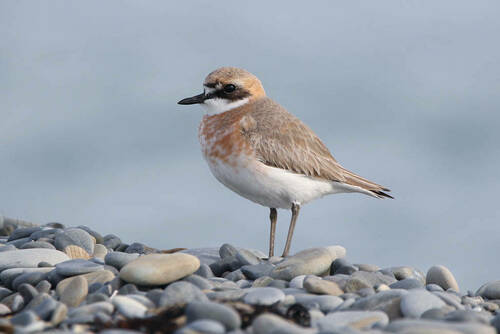
Greater Sand-Plover
Anarhynchus leschenaultii
A globetrotting shorebird known for its striking chestnut breast band and impressive migrations across continents. This leggy wader is a master of the 'run-and-pause' hunt on the world's most beautiful coastlines.
Quick Identification
Size
Length 22–25 cm (8.7–9.8 in); Wingspan 53–60 cm (21–24 in); Weight 75–120 g (2.6–4.2 oz)
Colors
Sandy-brown upperparts and white underparts. Breeding males have a bright chestnut breast band and a black mask. Non-breeding adults are grey-brown above with white below.
Key Features
- Long, heavy black bill
- Broad chestnut breast band in breeding plumage
- Pale greenish-grey legs
- Distinctly 'leggy' and upright posture
When You’ll See Them
Geographic range
Where Does the Greater Sand-Plover Live?
This globetrotting wader is native to the vast expanses of Central Asia, where it breeds in the arid steppes of Turkey, Mongolia, and western China. As a long-distance migrant, its non-breeding range spans the tropical coastlines of East Africa, the Middle East, South Asia, and all the way to the shores of Australia and the Pacific Islands. It is most commonly encountered along the shores of the Indian Ocean and the western Pacific, where it finds refuge in expansive intertidal zones.
Basemap © OpenStreetMap contributors
Behavior
The Greater Sand-Plover is a master of the 'run-and-pause' foraging technique common to shorebirds. On coastal mudflats, they sprint across the sand, stop abruptly to scan for movement with their large eyes, and then strike with their heavy bills. While they are often seen in small groups, they can form large, impressive flocks during high tide when they congregate at communal roosts, often mixing with other waders like curlews and godwits.
These birds are highly migratory and possess incredible stamina, traveling thousands of miles between their inland breeding grounds in the high-altitude steppes and their coastal wintering homes. While generally wary of humans, they can become quite accustomed to activity on busy beaches, provided a respectful distance is maintained. During the breeding season, they are more territorial, using vocal displays and low-level 'butterfly' flights to defend their nesting sites in arid environments.
EverydayEarth exclusive
Camera Tips
Capturing the Greater Sand-Plover on camera requires a keen understanding of the local tidal cycles. Position your AI-powered camera at the 'wrack line'—the high-tide mark where seaweed and debris accumulate—since these birds often forage or roost just above the rising water. A low-angle mount is essential for high-quality wildlife photography; placing the camera just 6 to 12 inches off the ground will provide a dramatic, eye-level perspective that highlights the bird’s characteristic thick bill and leggy stature.
Because they are naturally wary, camouflage is your best friend. Use a camera with a neutral-colored housing or a 'stone' or 'sand' skin to blend into the beach environment. Unlike backyard songbirds, you cannot easily bait plovers with seeds; instead, look for natural 'pinch points' like narrow spits of sand, small gaps between rock pools, or freshwater outlets on the beach where the birds are funnelled as they follow the tide. Early morning and late afternoon light are the best times for capturing the subtle sandy tones of their plumage without harsh glare from the sand.
Setting your camera to a high shutter speed or 'burst mode' is critical, as these birds move in sudden, fast spurts. If your camera supports specific AI-triggering, set it to 'Small Bird' or 'Shorebird' modes to ensure the focus locks onto their fast-moving bodies rather than the shifting background of the waves. Be extremely mindful of the salt spray in coastal environments—ensure your camera has a high IP rating for water resistance and clean the lens regularly with a dedicated microfiber cloth to prevent salt crusting from blurring your shots.
Similar Species
Species that look similar or are commonly confused with Greater Sand-Plover.
Frequently Asked Questions
Record Greater Sand-Plover at your habitat
Connect a camera to start building your own species record — AI identifies every visitor automatically.