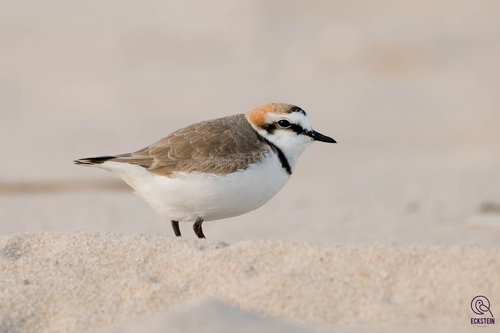
Kentish Plover
Anarhynchus alexandrinus
A delicate master of the shoreline, the Kentish Plover is a tiny wader with a big personality. From its lightning-fast sprints across the sand to its clever 'broken-wing' trickery, this coastal specialist is a marvel of camouflage and survival.
Quick Identification
Size
Length: 15–17.5 cm (6–7 in); Wingspan: 42–45 cm (16.5–18 in); Weight: 32–56 g (1.1–2 oz)
Colors
Pale sandy-grey upperparts and white underparts. Males feature a rufous crown and black markings on the forehead and neck; females are duller with brown replacing the black.
Key Features
- Incomplete black or dark brown breast band (patches on neck sides)
- Dark grey or blackish legs
- Thin, black bill
- White collar and forehead
When You’ll See Them
Geographic range
Where Does the Kentish Plover Live?
The Kentish Plover is primarily a resident of the Old World, with a native range spanning across Europe, Asia, and North Africa. It is most densely populated around the Mediterranean basin and across the temperate salt lakes of Central Asia, though migratory populations travel as far south as South Africa and Southeast Asia during the winter months.
Basemap © OpenStreetMap contributors
Behavior
The Kentish Plover is a high-energy wader known for its distinctive 'run-and-pause' foraging style. It darts across sandy or muddy surfaces with incredible speed, stopping abruptly to scan for movement before striking at prey. This behavior is both a hunting strategy and a way to avoid detection by predators in wide-open coastal environments.
During the breeding season, these birds are famous for their 'broken-wing' distraction display. If a predator or human approaches their ground-nesting site, the adult will feign a wing injury and lead the intruder away from the camouflaged eggs or chicks. They are generally social outside of the breeding season, often forming small flocks with other shorebirds at rich feeding grounds.
EverydayEarth exclusive
Camera Tips
To capture the Kentish Plover effectively, ground-level camera placement is the most critical factor. These birds spend nearly 100% of their time on foot, and their pale plumage is designed to blend into the sand when viewed from above. Mounting your camera just 4 to 6 inches off the ground using a 'ground spike' or a low-profile tripod will provide an intimate, eye-level perspective that reveals the fine details of their plumage and their expressive dark eyes.
Target the 'wrack line'—the strip of seaweed and debris left on the beach by the high tide. This area is a magnet for the small insects and crustaceans that Kentish Plovers hunt. If you are near a salt pan or lagoon, place the camera where the mud is damp but not submerged. Because these birds are sensitive to movement, using an AI-powered camera with a high-speed shutter or 'burst mode' is essential to freeze their rapid running motions.
Avoid placing cameras directly on nests, as this can attract predators or cause the parents to abandon the eggs. Instead, look for established 'runs' or paths between the dunes and the water's edge. Early morning light is best, as the low sun angle creates long shadows that help the bird’s pale body stand out against the flat sand. If your camera allows for focal length adjustments, use a wide-angle setting to capture the bird within its vast, minimalist habitat.
Similar Species
Species that look similar or are commonly confused with Kentish Plover.
Common Ringed Plover
Has a full, solid black breast band and bright orange legs, unlike the Kentish's broken band and dark legs.
Little Ringed Plover
Distinguishable by a prominent yellow eye-ring and a lack of the white wing-bar visible on the Kentish Plover in flight.
Snowy Plover
The New World counterpart; nearly identical in appearance but found exclusively in the Americas.
Frequently Asked Questions
Record Kentish Plover at your habitat
Connect a camera to start building your own species record — AI identifies every visitor automatically.