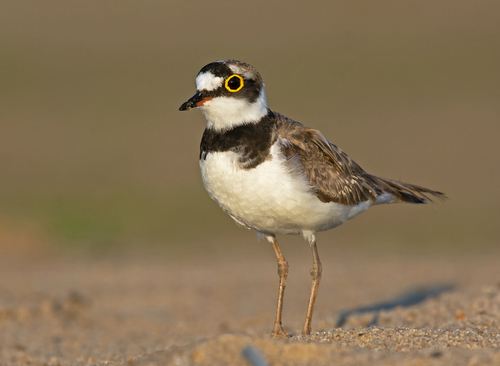
Little Ringed Plover
Thinornis dubius
A pint-sized powerhouse of the riverbanks, the Little Ringed Plover is best known for its vivid yellow 'goggles' and its incredible journey across continents.
Quick Identification
Size
14-17 cm (5.5-6.7 in) in length, with a 42-48 cm (16.5-19 in) wingspan; weighs 25-50 g (0.9-1.8 oz)
Colors
Brownish-grey upperparts and white underparts; features a bold black breast band and a black-and-white head pattern with a signature bright yellow fleshy eye ring.
Key Features
- Distinctive bright yellow eye ring
- Solid black neck band that does not break at the throat
- Dull pinkish or yellowish legs, never bright orange
- Lack of a white wing bar when in flight
When You’ll See Them
Geographic range
Where Does the Little Ringed Plover Live?
The Little Ringed Plover is primarily a bird of the Palearctic, with a massive breeding range that spans from Western Europe and North Africa across Central Asia to Japan. In the summer months, they are widely distributed across temperate Eurasia, favoring river systems and man-made gravel excavations. As winter approaches, these birds embark on significant migrations, traveling to the tropical climates of sub-Saharan Africa, South Asia, and the islands of Southeast Asia to find warmer feeding grounds.
Basemap © OpenStreetMap contributors
Behavior
The Little Ringed Plover is a high-energy shorebird known for its distinctive 'run-stop-peck' foraging rhythm. They are highly territorial during the nesting season, often seen defending patches of gravel with rapid, low-level flights and piping calls. Unlike many other shorebirds, they prefer freshwater environments over coastal beaches, making them a common sight around inland wetlands and industrial sites.
One of their most fascinating behaviors is the 'broken wing' display used to protect their nests. If a predator or human gets too close to their eggs—which are laid directly on the ground in a shallow scrape—the adult will feign a wing injury to lead the intruder away. Once the threat is at a safe distance, the bird 'miraculously' recovers and flies back to its clutch. They are generally solitary or found in pairs, though they may form small, loose groups during their long-distance migrations.
EverydayEarth exclusive
Camera Tips
Capturing the Little Ringed Plover on camera requires a 'ground-up' approach. Because these birds spend nearly all their time on the earth, your camera should be mounted no more than 4-6 inches off the ground. If you are monitoring a backyard pond or a gravelly area, aim the camera parallel to the ground rather than pointing it down. This perspective captures the bird’s striking profile and that essential yellow eye ring, rather than just a top-down view of its brown back which can easily blend into the substrate.
Focus your efforts on transition zones—the area where dry gravel or sand meets soft mud or water. Little Ringed Plovers are attracted to these 'edges' because they provide the best hunting grounds for insects. If you have a backyard with a water feature, creating a small, flat area of exposed gravel or sand at the water's edge is the best way to lure them into your camera's field of view. They do not visit traditional bird feeders, so habitat modification is your 'bait' here.
Because these birds are incredibly fast and prone to sudden, jerky movements, use the fastest shutter speed your camera allows. If your AI camera has an 'Action' or 'Sports' mode, enable it to prevent motion blur. Set your camera to take a 3-5 photo burst; the first shot often catches the bird mid-run, while the third or fourth usually captures it in a stationary, alert pose. High-quality daylight lighting is crucial, as their fine feather details can be lost in deep shadows.
During the breeding season (mid-spring to early summer), be extremely careful not to disturb potential nesting sites. If you see a bird performing a distraction display, you are too close. Use a camera with a long-range PIR sensor so you can set it up 10-15 feet away from their preferred foraging spots, minimizing the need for you to approach the area frequently to change batteries or SD cards.
Similar Species
Species that look similar or are commonly confused with Little Ringed Plover.
Frequently Asked Questions
Record Little Ringed Plover at your habitat
Connect a camera to start building your own species record — AI identifies every visitor automatically.