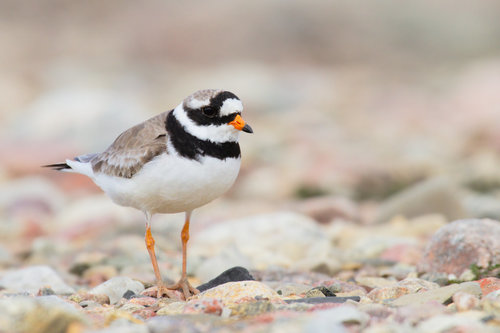
Common Ringed Plover
Charadrius hiaticula
With its iconic black neck ring and bright orange legs, the Common Ringed Plover is the spirited sprinter of the shoreline. Watch as this master of disguise uses clever 'broken-wing' tactics to protect its pebbly nest.
Quick Identification
Size
Length: 18–20 cm (7–8 in); Wingspan: 48–57 cm (19–22 in); Weight: 42–78 g (1.5–2.8 oz)
Colors
Sand-brown upperparts and white underparts; distinctive black-and-white head pattern with a bold black breast band; bright orange legs and an orange bill with a black tip.
Key Features
- Broad black breast band forming a complete 'ring'
- Bright orange legs and orange-based bill
- Large dark eyes set within a black facial mask
- Rapid 'run-and-stop' foraging movement
When You’ll See Them
Geographic range
Where Does the Common Ringed Plover Live?
Common Ringed Plovers are native to the northern reaches of Eurasia and Greenland, where they breed during the short Arctic and temperate summers. Their core breeding range extends from the United Kingdom and Scandinavia across the Russian tundra, with significant populations also found in Iceland and the Canadian Arctic. As the seasons change, these hardy travelers undertake impressive migrations to winter along the coasts of Western Europe, the Mediterranean, and as far south as the tip of South Africa.
Basemap © OpenStreetMap contributors
Behavior
The Common Ringed Plover is a master of the shoreline, recognized by its energetic 'run-and-pause' foraging style. It darts across the sand, stops suddenly to tilt its head, and snatches up small invertebrates. This species is highly territorial during the breeding season, often performing a dramatic 'broken-wing' display to lure potential predators away from its camouflaged ground nest. By pretending to be injured, the adult draws the threat away before taking flight at the last second.
Outside of the breeding season, these plovers become more gregarious, often forming large mixed flocks with other waders like Dunlins and Sanderlings. They are well-adapted to coastal environments but are sensitive to human disturbance, particularly during the nesting season when their eggs—which look exactly like pebbles—are easily stepped on. While they are mostly diurnal, they will also feed at night by moonlight to take advantage of falling tides.
EverydayEarth exclusive
Camera Tips
To capture high-quality footage of the Common Ringed Plover, camera placement is everything. You must position your camera extremely low to the ground—ideally no more than 4 to 8 inches high. This 'eye-level' perspective provides an intimate look at the bird and makes the background blur beautifully. Use a ground spike or a weighted 'pancake' mount on the sand near the high-tide line or the edge of a brackish pond.
Because these birds are small and move with lightning speed, your camera's trigger speed must be set to its fastest possible setting. Increase the motion sensitivity to 'High' to ensure the camera picks up their rapid movements. If your camera allows for 'Burst Mode' or 'Multi-Shot,' enable it; capturing a sequence of shots increases the chances of getting a clear image while the bird is paused between its characteristic runs.
Timing is dictated by the moon. These birds are most active when the tide is receding, exposing fresh mud and sand. Check local tide tables and aim to have your camera active two hours before and after low tide. If you are setting up in a backyard that borders a beach, providing a small area of open, flat gravel or sand can sometimes encourage them to stop and rest, but avoid placing cameras near tall vegetation where they fear predators might lurk.
Similar Species
Species that look similar or are commonly confused with Common Ringed Plover.
Frequently Asked Questions
Record Common Ringed Plover at your habitat
Connect a camera to start building your own species record — AI identifies every visitor automatically.