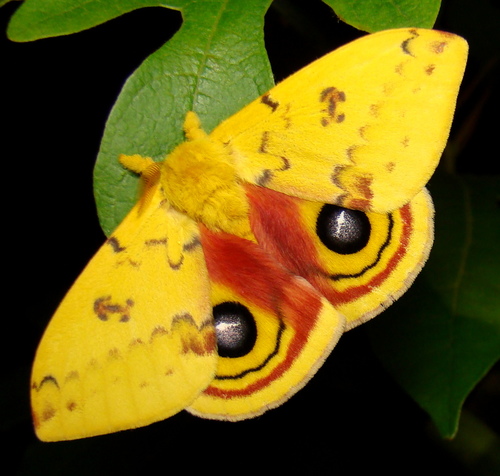
Io Moth
Automeris io
With a dramatic 'startle' display that mimics the eyes of a much larger animal, the Io moth is a brilliant example of nature's defensive artistry. Whether it's the sunny yellow of the male or the deep mahogany of the female, spotting one of these giant silk moths is a true backyard highlight.
Quick Identification
Size
Wingspan ranges from 6 to 9 cm (2.5 to 3.5 inches)
Colors
Males are bright lemon-yellow; females are reddish-brown to purple-brown; both have large black and blue hindwing eyespots
Key Features
- Large, dramatic 'eyespots' on the hindwings with blue centers and black borders
- Extreme sexual dimorphism with yellow males and brown females
- Prominent white 'discal' spot on the center of the forewings
- Furry, thick bodies typical of giant silk moths
When You’ll See Them
Behavior
The Io moth is a master of deception and one of the most charismatic nocturnal visitors to North American backyards. Their most famous behavior is the 'startle display'; when resting, they keep their duller forewings closed to look like a dead leaf, but if disturbed by a predator, they suddenly snap their wings open to reveal massive, staring eyespots. This visual shock is often enough to send a hungry bird flying in the opposite direction.
Because they belong to the Saturniidae family, adult Io moths possess no functional mouthparts and do not eat. Their entire adult existence—usually lasting only 7 to 14 days—is dedicated strictly to reproduction. Males use their large, feathery antennae to sense the pheromones released by females from miles away, flying through the night to find a mate before their limited energy reserves run out.
EverydayEarth exclusive
Camera Tips
Capturing the Io moth on camera requires a bit of strategy since standard motion-activated trail cameras are often not sensitive enough to trigger on a moth's flight. To successfully document them, set up a 'moth station' using a white bedsheet draped over a fence or line, illuminated by a UV light or a strong LED. Position your camera on a tripod roughly 3 to 5 feet from the sheet. Use a 'Time Lapse' mode rather than 'Motion' mode, setting the interval to one photo every 30 to 60 seconds to ensure you catch visitors as they land and rest on the fabric.
For the most striking photos, look for them during the late spring and early summer. If you have a camera with a macro lens or high-resolution close-up capabilities, focus on the texture of the wings. To see the famous eyespots, you might need to be present; the moth usually hides them while resting. A gentle puff of air can sometimes cause them to shift their wings and reveal the 'eyes' for your camera.
Be mindful of the caterpillars as well! If your camera is set up near host plants like hibiscus or oak, you might spot the bright green, 'pompom-like' larvae. However, do not handle them; those pretty green spines are venomous and deliver a painful sting. In terms of camera settings, ensure your flash is set to a low or diffused power to avoid washing out the intricate yellow or brown scales of the wings.
Similar Species
Species that look similar or are commonly confused with Io Moth.
Frequently Asked Questions
Record Io Moth at your habitat
Connect a camera to start building your own species record — AI identifies every visitor automatically.