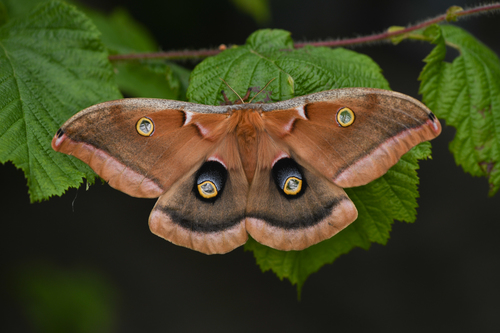
Polyphemus Moth
Antheraea polyphemus
Meet the titan of the backyard: the Polyphemus moth. With its massive wingspan and hypnotic eyespots, this nocturnal beauty is one of the most rewarding sightings for any backyard explorer.
Quick Identification
Size
Wingspan of 10–15 cm (4–6 in)
Colors
Tan to reddish-brown wings with transparent 'windows'; hindwings feature large yellow, blue, and black eyespots. Males have very broad, feathery antennae.
Key Features
- Large purplish-blue eyespots on hindwings
- Translucent window-like spots in the center of each wing
- Tan or cinnamon-colored body and wings
- Broad, feathery antennae (especially in males)
When You’ll See Them
Behavior
The Polyphemus moth is a gentle giant of the night, living a brief but spectacular life. As an adult, this moth has no functioning mouth and does not eat; it lives for only about a week on energy reserves stored from its time as a caterpillar. Its entire adult existence is dedicated to reproduction. Males spend their nights flying long distances, using their sensitive antennae to 'smell' the pheromones of females from miles away.
When resting during the day, the Polyphemus moth relies on its earthy tones to blend in with dried leaves and tree bark. If a predator discovers it, the moth has a dramatic trick: it flips its forewings forward to reveal two massive, startling eyespots on its hindwings. This sudden 'stare' is often enough to frighten off birds or small mammals, giving the moth a chance to escape into the shadows.
EverydayEarth exclusive
Camera Tips
Capturing a Polyphemus moth on camera requires a bit of 'light' strategy. These moths are strongly attracted to light sources, so the most effective setup is to place your camera near a porch light or a dedicated UV 'blacklight' station. Hang a white sheet against a wall or between trees and shine the light onto it; your AI camera should be mounted on a tripod 3 to 5 feet away, focused on the sheet. This setup creates a high-contrast background that makes it easy for AI detection to trigger when the moth lands.
Since these moths are most active in the middle of the night, ensure your camera's infrared (IR) night vision is optimized. To get the best detail of the intricate wing patterns, try to position the camera at a 90-degree angle to the landing surface. If your camera allows for 'burst' photos, enable it; moths often flutter their wings rapidly upon landing, and a burst of shots increases your chances of getting one perfectly clear image where the wings are fully spread.
For those looking to capture the ultimate 'emergence' video, keep an eye out for their cocoons in late winter and early spring. They are often wrapped in a leaf and can be found on the ground or hanging from twigs of host trees like maple or oak. If you find one, mount your camera just a few inches away. The process of the moth crawling out and inflating its wings can take several hours, so ensure your camera is plugged into a power source or has a fresh battery pack to capture the entire transformation.
Similar Species
Species that look similar or are commonly confused with Polyphemus Moth.
Frequently Asked Questions
Record Polyphemus Moth at your habitat
Connect a camera to start building your own species record — AI identifies every visitor automatically.