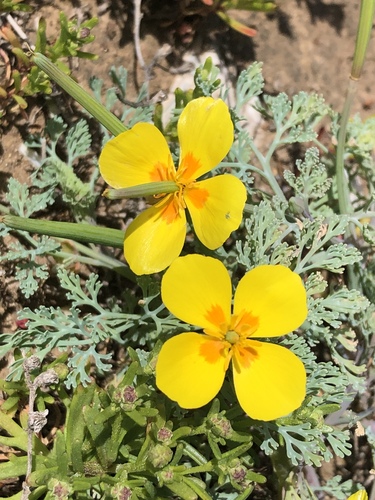
island poppy
Eschscholzia ramosa
The island poppy is a golden treasure of the Pacific, painting the rocky bluffs of the Channel Islands in brilliant shades of lemon and tangerine. This hardy native is a master of the coastal breeze, showing off its lacy blue foliage and sun-loving blooms.
Quick Identification
Size
Stands 4 to 12 inches (10–30 cm) tall; flowers typically 0.5 to 1.5 inches (1.3–3.8 cm) in diameter.
Colors
Brilliant yellow to deep orange petals, often featuring a darker orange or reddish spot at the base; foliage is a distinctive glaucous blue-green.
Key Features
- Finely divided, lacy blue-green foliage
- Four bright yellow or orange petals
- Small, compact annual growth habit
- Cylindrical seed pods that split when dry
When You’ll See Them
Behavior
The island poppy is a resilient annual herb that has specialized for life in the rugged, wind-swept environments of the Channel Islands. Unlike its mainland cousin, this species is built for the coastal elements, maintaining a low profile to avoid the shearing forces of Pacific winds. Its most notable 'behavior' is nyctinasty—the rhythmic opening and closing of its petals. The flowers unfurl in the mid-morning to greet the sun and close tightly by late afternoon or during heavy fog.
This species follows a rapid lifecycle triggered by winter and spring rains. It germinates quickly, flowers in a burst of color to attract native pollinators like sweat bees and hoverflies, and then sets seed before the summer drought begins. While it doesn't 'interact' with humans in a traditional sense, it is a vital part of island restoration efforts and a favorite for native plant enthusiasts due to its tidy growth habit and vibrant display.
EverydayEarth exclusive
Camera Tips
To capture the island poppy on your trail camera, you need to think small and low. Since these plants rarely exceed a foot in height, avoid mounting your camera on a standard tree trunk. Instead, use a ground stake or a specialized low-profile mount positioned just 6 to 10 inches off the ground. Angle the lens slightly upward; this perspective makes the small flowers look majestic and allows the camera to capture the sunlight filtering through the delicate, translucent petals.
Time-lapse mode is the secret weapon for plant photography. Rather than relying on motion triggers—which might be falsely set off by the wind blowing the stems—set your camera to take an image every 10 to 20 minutes during daylight hours. When stitched together, this footage creates a stunning visual narrative of the flowers 'waking up' as they bloom in the morning and 'going to sleep' as they tuck their petals away for the night.
Lighting is everything with the island poppy. Because their petals are highly reflective and bright yellow, they can easily 'blow out' or lose detail in direct, harsh midday sun. If possible, position your camera so the flowers are backlit during the golden hour (just before sunset), or choose a spot that receives bright but slightly filtered light. This will emphasize the blue-green texture of the foliage and the saturated color of the blooms without overexposing the image.
Finally, consider the seasonal timing. These poppies are 'ephemeral,' meaning they appear and disappear quickly based on rainfall. Start monitoring your site in late February. Once you see the lacy, blue-green seedlings emerge, clear any tall dried grass from the immediate foreground that might obscure the camera's view. A clean frame with a dark background, like a volcanic rock or deep green shrub, will help the bright yellow flowers stand out in your captures.
Similar Species
Species that look similar or are commonly confused with island poppy.
California Poppy
Larger flowers and broader leaf segments; lacks the compact, island-specific growth habit of the island poppy.
Frying Pans
Also known as Eschscholzia lobbii, these are much smaller, have pure yellow flowers without orange centers, and are found in the Central Valley/foothills rather than the islands.
Frequently Asked Questions
Record island poppy at your habitat
Connect a camera to start building your own species record — AI identifies every visitor automatically.