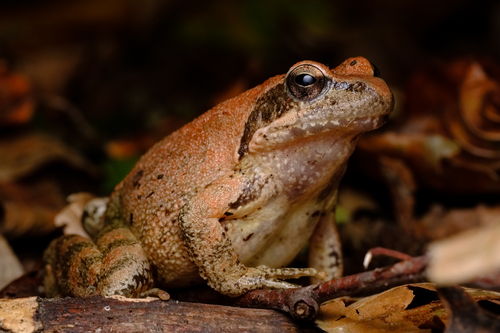
Italian Stream Frog
Rana italica
A specialized resident of Italy's rushing mountain brooks, the Italian Stream Frog is a master of camouflage and high-speed escapes. With its signature dark mask and incredible jumping range, it is a prized find for any backyard naturalist near the Apennines.
Quick Identification
Size
A small to medium-sized frog reaching 40–55 mm (1.6–2.2 inches) in length, with females being notably larger than males.
Colors
Typically reddish-brown, tan, or ochre-colored dorsal skin. They feature a distinct dark brown 'mask' or temporal patch behind the eye and a creamy white to yellowish underside with greyish mottling.
Key Features
- Dark brown temporal mask behind the eye
- Extremely long hind legs adapted for jumping
- V-shaped marking on the throat
- Prominent light-colored dorsolateral folds along the back
When You’ll See Them
Geographic range
Where Does the Italian Stream Frog Live?
The Italian Stream Frog is a European endemic found exclusively on the Italian Peninsula and within the Republic of San Marino. Its range extends from the northern Apennines in Liguria and Emilia-Romagna all the way south to the tip of Calabria. It is most concentrated in the hilly and mountainous interior regions and is conspicuously absent from the islands of Sicily and Sardinia.
Basemap © OpenStreetMap contributors
Behavior
The Italian Stream Frog is a shy and remarkably agile jumper, highly specialized for life alongside the cool, fast-flowing waters of the Apennine Mountains. Unlike common pond frogs, this species is built for the current, spending much of its time on mossy rocks or damp banks where it can leap into the safety of the water at the first sign of danger. They are known for their incredible leaping ability, often covering several feet in a single bound to escape predators.
While they are primarily solitary creatures, they congregate near breeding sites in the early spring. They are less vocal than many other frogs, producing soft, rhythmic grunting sounds that are often drowned out by the noise of rushing water. They are active during both the day and night, frequently seen basking in the sun to regulate their body temperature while remaining vigilant for passing insects.
EverydayEarth exclusive
Camera Tips
To successfully capture the Italian Stream Frog on a trail camera, placement is everything. Focus your efforts on the 'splash zone'—the area where mountain streams create small waterfalls or eddies. Look for flat, moss-covered rocks or partially submerged logs that serve as sunning platforms. Set your camera extremely low, ideally no more than 10-15 centimeters (4-6 inches) off the ground, and angle it slightly upward to catch the frog's profile against the water.
Because these frogs are relatively small and move with lightning speed, use a camera with a high-speed trigger and a short recovery time. If your camera has a 'macro' or 'close-focus' setting, enable it, as you will likely need to place the device within 1 to 3 feet of the target basking spot. Avoid placing the camera in direct, harsh sunlight, as the glare off the wet rocks can overexpose your images; dappled shade provides the most natural lighting for their reddish-brown skin.
While these frogs aren't typically attracted to traditional baits, you can encourage them to visit a specific spot by creating a 'micro-habitat' in front of your camera. A flat, wet stone placed in a shallow part of a stream, surrounded by local moss, is an irresistible sunning spot. During the spring breeding season, early morning hours after a light rain are the most productive times for activity, as the frogs are more bold and active on the banks.
Similar Species
Species that look similar or are commonly confused with Italian Stream Frog.
Frequently Asked Questions
Record Italian Stream Frog at your habitat
Connect a camera to start building your own species record — AI identifies every visitor automatically.