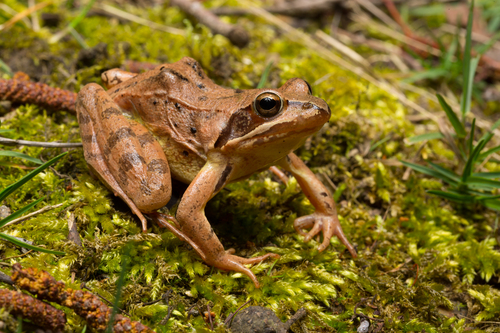
Agile Frog
Rana dalmatina
A master of the long jump, the Agile Frog can leap over six feet in a single bound to escape danger. This elegant, long-legged amphibian is one of Europe's earliest signs of spring, emerging while forests are still waking from winter.
Quick Identification
Size
Body length 6-9 cm (2.4-3.5 inches); hind legs can reach up to 12 cm (4.7 inches)
Colors
Light brown, beige, or pinkish-grey dorsal side; dark brown temporal mask behind the eye; creamy white underside with no spotting
Key Features
- Extremely long hind legs that extend past the snout when folded forward
- Distinct dark mask covering the eye and eardrum
- Pointed snout and slender, athletic body
- Large eardrum (tympanum) nearly the same size as the eye
When You’ll See Them
Geographic range
Where Does the Agile Frog Live?
The Agile Frog is a quintessential European resident, found across the central and southern parts of the continent. Its range stretches from northern Spain and France through Central Europe into the Balkans and parts of northern Greece. While it is widely distributed in countries like Germany, Italy, and Hungary, it is much rarer at the northern edges of its range, with small, protected populations in Denmark and the southernmost tip of Sweden.
Basemap © OpenStreetMap contributors
Behavior
The Agile Frog is the undisputed track star of the amphibian world. True to its name, it is capable of making incredible leaps of up to two meters (over 6 feet) when startled, a feat powered by its disproportionately long hind legs. Unlike many of its cousins that prefer to stay submerged, this species is highly terrestrial, spending much of its adult life in damp deciduous forests and meadows far from standing water.
During the breeding season, which occurs very early in the year—often while ice still lingers on ponds—males gather to emit a soft, repetitive 'cooing' or 'clicking' call from underwater. They are not particularly social and do not form the massive, noisy choruses typical of other European frogs. Outside of the spring mating period, they are quiet, solitary hunters that rely on camouflage and speed to evade predators like snakes and birds.
EverydayEarth exclusive
Camera Tips
To capture the Agile Frog on camera, timing is everything. They are among the earliest amphibians to emerge from hibernation, often moving toward breeding ponds in late February or early March. Set your camera near the water's edge of shallow, sun-exposed ponds during this window. Look for submerged vegetation where they attach their egg clumps, as males will often linger nearby. Position the camera just 5-10 centimeters (2-4 inches) off the ground to match their low-profile perspective.
Because these frogs are incredibly fast and sensitive to movement, using a camera with a high-speed trigger and a wide-angle lens is essential. If your camera allows for video, set it to a high frame rate (at least 60fps). This increases your chances of capturing their signature two-meter leap in detail rather than just a brown blur. Focus on areas with thick leaf litter or near the base of old logs, as these are favorite hiding spots when they are not in the water.
Lighting is another crucial factor. During the summer, they are most active during the 'blue hour' of twilight. If using an infrared (IR) flash, ensure it has a 'No-Glow' feature to avoid startling the frog or washing out its subtle beige markings. In backyards, you can encourage them to pose by creating a 'frog hotel' out of stacked stones or damp wood near a garden pond; placing the camera facing the entrance of these cool, damp shelters is a reliable way to get high-quality close-ups.
Similar Species
Species that look similar or are commonly confused with Agile Frog.
Frequently Asked Questions
Record Agile Frog at your habitat
Connect a camera to start building your own species record — AI identifies every visitor automatically.