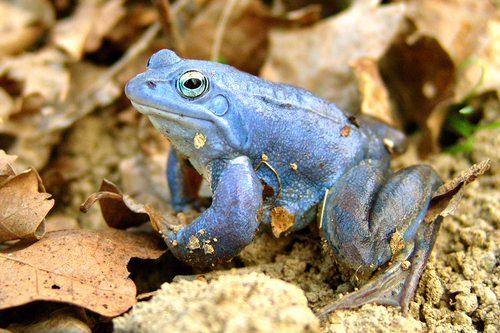
Moor Frog
Rana arvalis
Meet the Moor Frog, a master of transformation that survives the frozen winter only to turn a brilliant sky-blue come spring. This resilient Eurasian native is a crown jewel of the wetlands, offering a rare spectacle for backyard observers.
Quick Identification
Size
5.5 to 7.0 cm (2.2 to 2.8 inches) in length; weighing 20-50 grams
Colors
Reddish-brown or grayish-brown with dark spots; males turn a striking sky-blue during the peak of the breeding season.
Key Features
- Pointed snout and slim body profile
- Dark 'mask' or temple spot extending behind the eye
- Males turn bright blue during the spring mating window
- Hard, enlarged tubercle on the hind foot for digging
When You’ll See Them
Geographic range
Where Does the Moor Frog Live?
The Moor Frog is a quintessential Eurasian species, spanning a massive territory from Central and Northern Europe through to Siberia and the Altai Mountains. You can find them in high concentrations throughout countries like Poland, Germany, and Russia, where the landscape provides the damp, acidic wetlands they crave. While they are widely distributed across the continent, they are notably absent from the Iberian Peninsula and much of the Mediterranean south.
Basemap © OpenStreetMap contributors
Behavior
The Moor Frog is one of nature's most resilient survivors, uniquely adapted to harsh northern climates. It is famous for its physiological ability to freeze solid during winter, using natural cryoprotectants like glucose to prevent cell damage while its heart stops beating. Once the spring thaw arrives, they emerge with incredible speed to begin their brief, high-energy breeding cycle.
During the mating season, these frogs exhibit 'multimale amplexus,' where many males compete for a single female in shallow waters. This is the only time the males display their iconic blue coloration, which acts as a signal of health and fitness. Outside of this short window, they are largely terrestrial and solitary, spending their days hiding in damp vegetation or leaf litter to maintain moisture.
EverydayEarth exclusive
Camera Tips
To capture the elusive blue phase of the Moor Frog, timing and placement are everything. These frogs only change color for about 3 to 7 days during the peak of the spring breeding season, usually shortly after the first major thaw. Set your camera at the very edge of shallow, sun-exposed ponds or flooded meadows. Because these frogs are small and stay low, the camera should be mounted no higher than 10-15 centimeters (4-6 inches) off the ground, angled slightly downward to capture the water's surface and the bank.
Focusing is the biggest challenge with small amphibians. If your camera has a 'macro' or 'close-up' mode, enable it, and try to pre-focus on a specific 'calling site'—typically a clump of reeds or a submerged log where males congregate to croak. Since Moor Frogs are shy and have fast reflexes, a camera with a high-speed trigger and a 'burst' photo mode is ideal for catching them in motion or during amplexus.
While you shouldn't use food bait, you can use 'habitat lures.' Placing a flat, dark stone or a partially submerged log in a sunny spot can attract frogs looking to bask and regulate their body temperature. In the summer months, when they move into terrestrial habitats, place your camera along damp corridors in tall grass or near the base of a garden compost pile where insect activity is high. Avoid using bright white flashes at night; infrared LEDs are much less likely to startle them or wash out their delicate coloration.
Similar Species
Species that look similar or are commonly confused with Moor Frog.
Frequently Asked Questions
Record Moor Frog at your habitat
Connect a camera to start building your own species record — AI identifies every visitor automatically.