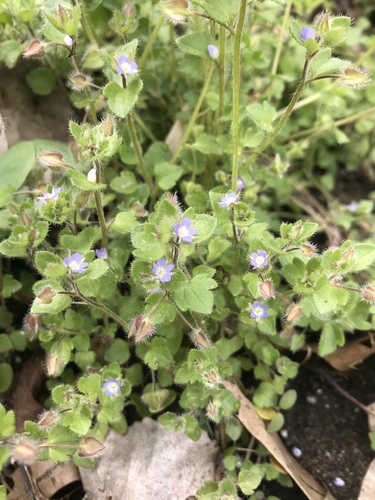
Ivy-leaved Speedwell
Veronica hederifolia
A delicate early-spring herald, the Ivy-leaved Speedwell carpets garden floors with tiny lilac blooms and distinctive lobed foliage. This resilient plant provides essential early nectar for pollinators and adds a touch of wild beauty to the quiet corners of our suburban landscapes.
Quick Identification
Size
Stems 10–60 cm (4–24 in) long; flowers 2–5 mm (0.08–0.2 in) wide
Colors
Pale lilac to light blue flowers with white centers; dull green leaves often with purplish undersides
Key Features
- Ivy-shaped leaves with 3-5 distinct lobes
- Solitary pale blue or lilac flowers growing from leaf axils
- Sprawling, hairy stems that form low-growing mats
- Flower stalks (pedicels) are shorter than the leaves
When You’ll See Them
Behavior
Ivy-leaved Speedwell is a resilient annual plant that serves as one of the earliest harbingers of spring. Unlike many garden plants that wait for the warmth of May, this species completes much of its life cycle while the ground is still cool. Its sprawling growth habit allows it to quickly colonize bare patches of soil, creating a protective green carpet that helps prevent erosion and retains moisture in the early season.
While it is frequently classified as a weed in agricultural settings, in a backyard ecosystem, it is a vital player. It exhibits nyctinasty, meaning its tiny flowers close up at night or during cloudy weather to protect their delicate reproductive organs. This plant is non-invasive in a way that displaces all others; rather, it fills the temporary gaps in the landscape before taller summer perennials emerge and shade it out.
EverydayEarth exclusive
Camera Tips
Capturing the Ivy-leaved Speedwell with an AI-powered backyard camera requires a focus on macro-level detail. Because these plants hug the ground and feature flowers no larger than a peppercorn, you must position your camera at a very low 'worm's-eye' view. If your camera allows for adjustable focus, set it to its closest possible range. Mounting the camera on a small stake just 3 to 5 inches above the ground will provide the best perspective of the unique ivy-like leaf lobes and the delicate veining on the lilac petals.
Time-lapse is the ideal setting for this species. By capturing a frame every 15 minutes during the day, you can document the plant's daily rhythm as the flowers unfurl in response to the morning sun and tuck themselves away as evening approaches. This setting also highlights the rapid growth of the sprawling stems, which can seem to 'crawl' across the soil over the course of a week. For the best lighting, try to position the camera so the plant receives dappled sunlight; the pale color of the flowers can easily become 'blown out' or overexposed in harsh, direct midday sun.
Don't just look for the plant—look for the visitors. Ivy-leaved Speedwell is a crucial early-season nectar source. Set your camera’s motion trigger to its highest sensitivity to catch the tiny solitary bees and hoverflies that frequent these blooms in March and April. Because these insects move quickly, a high frame rate or a 'burst' photo mode is recommended. This allows you to see the symbiotic relationship between the speedwell and the first pollinators of the year, adding a layer of wildlife interaction to your botanical captures.
Seasonal timing is everything. Since this plant often withers and disappears by the time the summer heat arrives, you should have your camera deployed by late February or early March. Look for the emergence of the hairy, lobed leaves in shaded corners of your yard or near the base of hedges. Once the first pale blue dot appears in the leaf axil, you have about an eight-week window to capture the plant at its peak before it sets seed and goes dormant for the year.
Similar Species
Species that look similar or are commonly confused with Ivy-leaved Speedwell.
Frequently Asked Questions
Record Ivy-leaved Speedwell at your habitat
Connect a camera to start building your own species record — AI identifies every visitor automatically.