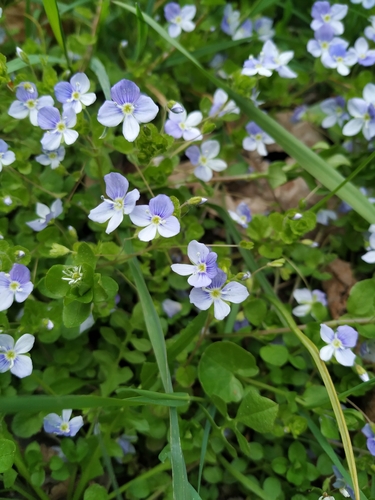
Slender speedwell
Veronica filiformis
The Slender speedwell is the master of the 'blue carpet' effect, turning ordinary spring lawns into a sea of delicate lilac-blue. This resilient creeper is a fascinating example of how nature adapts to live right under our feet.
Quick Identification
Size
Grows 1-2 inches (2.5-5 cm) tall; individual plants spread to form mats 12-20 inches (30-50 cm) wide
Colors
Pale blue to lilac petals with darker violet veins and a bright white center; foliage is a vivid light green
Key Features
- Four-petaled blue flowers on extremely long, thread-like stalks (pedicels)
- Low-growing, mat-forming habit that creeps along the soil
- Small, kidney-shaped leaves with rounded, scalloped edges
When You’ll See Them
Behavior
The plant exhibits 'sleep movements' or nyctinasty, where the flowers respond to light and moisture levels. On bright, sunny days, the blooms open wide to attract small pollinators like hoverflies and solitary bees. However, during rain or as evening approaches, the flowers fold inward to protect their pollen. This resilient species is remarkably well-adapted to human environments, as it can survive frequent lawn mowing by staying low to the ground and even benefits from the mower spreading chopped stem fragments that later take root elsewhere.
EverydayEarth exclusive
Camera Tips
Lighting is the biggest challenge for this species. The pale blue petals reflect a lot of light and can easily appear white or 'blown out' in direct mid-day sun, making it difficult for AI to identify the dark blue vein patterns. For the best results, set your camera to record during the golden hours of early morning or late afternoon. If you are using a camera with manual settings, a slight underexposure will help preserve the intricate violet lines on the petals that distinguish this species from other speedwells.
Because plants don't trigger traditional PIR (passive infrared) motion sensors, use the time-lapse mode on your camera. Setting a 5-minute interval during the peak flowering weeks of April and May will allow you to see the 'blue carpet' effect as the flowers open and close in response to the sun. This is also an excellent way to capture the tiny insects, such as bee flies and small syrphid flies, that frequent the blooms but might be too small or fast for standard motion triggers.
Finally, consider the moisture of the environment. Slender speedwell thrives in damp soil, which can lead to lens fogging in the early morning. If your camera is placed in a low, moist spot on the lawn, ensure the lens is clean and consider using an anti-fog wipe. Position the camera facing North or South to avoid the direct glare of the rising or setting sun, which can create lens flare that obscures the fine details of the thread-like stalks.
Similar Species
Species that look similar or are commonly confused with Slender speedwell.
Frequently Asked Questions
Record Slender speedwell at your habitat
Connect a camera to start building your own species record — AI identifies every visitor automatically.