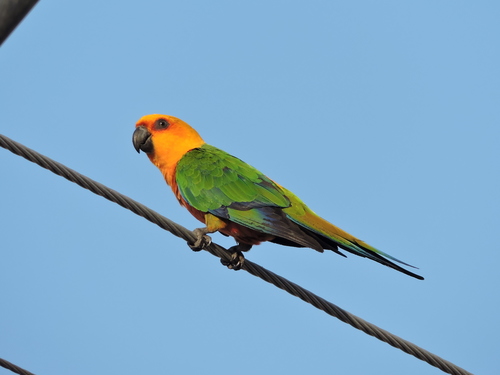
Jandaya Parakeet
Aratinga jandaya
An explosion of tropical color, the Jandaya Parakeet is the golden jewel of the Brazilian woods. Known for its fiery orange breast and playful spirit, this social parrot brings life and noise to the forest canopy.
Quick Identification
Size
Length of approximately 30 cm (12 in); wingspan of 45-50 cm (18-20 in); weight ranges from 125 to 140 g (4.4-4.9 oz).
Colors
Brilliant yellow head and neck with orange-red wash on the face and belly; wings and tail are deep green; black bill; grey feet.
Key Features
- Solid yellow head and neck with fiery orange facial highlights
- Deep green mantle and wings
- Long, tapering green tail
- Heavy, curved jet-black bill
When You’ll See Them
Geographic range
Where Does the Jandaya Parakeet Live?
The Jandaya Parakeet is a stunning endemic species native to the South American continent, specifically northeastern Brazil. Its core range encompasses a vast area including the states of Piauí, Maranhão, Ceará, and parts of Alagoas and Pernambuco. While they are lowland specialists of the Brazilian interior, occasional feral populations have been reported in urban areas outside their native range due to their popularity in the pet trade.
Basemap © OpenStreetMap contributors
Behavior
Jandaya Parakeets are highly social and gregarious birds, typically moving in small, tightly-knit flocks of 10 to 30 individuals. They are famously vocal, utilizing a range of high-pitched screeches to communicate while in flight or when alerting the group to potential predators. Within the flock, pairs are often monogamous and can be observed engaging in frequent mutual preening and "allofeeding" to strengthen their social bonds.
These parrots are energetic and inquisitive foragers. They spend much of their day moving between feeding sites, often hanging upside down with impressive dexterity to reach fruits or seeds on thin branches. While they are naturally cautious, they are increasingly common in suburban environments where they have learned to take advantage of bird feeders and cultivated fruit trees, often displaying a bold and playful temperament once they feel secure in their surroundings.
EverydayEarth exclusive
Camera Tips
To capture the brilliant plumage of the Jandaya Parakeet, mount your camera at an elevated position, roughly 10 to 15 feet high. They are canopy dwellers, so aiming your lens at a cross-section of branches in a fruiting tree—such as a mango, guava, or palm—is far more effective than ground-level placement. Use a slight downward angle to ensure the camera captures the bird's orange underbelly and green wings as it leans over to feed.
Attracting these parakeets to a backyard setup requires high-energy lures. A platform feeder stocked with sunflower seeds, cracked corn, or fresh tropical fruit slices (like papaya or oranges) will act as a magnet. Because they are social, once one bird finds the food, the whole flock will likely follow. Ensure your camera is set to a high trigger speed or burst mode, as these birds are constantly in motion, shifting and fluttering as they interact with flock mates.
Lighting is critical for this species; their yellow and orange feathers can easily 'wash out' in mid-day tropical sun. Position your camera facing north or south to take advantage of side-lighting during their peak activity hours in the early morning and late afternoon. This soft light will better define the individual feathers and the deep green of their wings. If using video, set clips for at least 20 seconds to capture their complex social behaviors and vocalizations.
Similar Species
Species that look similar or are commonly confused with Jandaya Parakeet.
Frequently Asked Questions
Record Jandaya Parakeet at your habitat
Connect a camera to start building your own species record — AI identifies every visitor automatically.