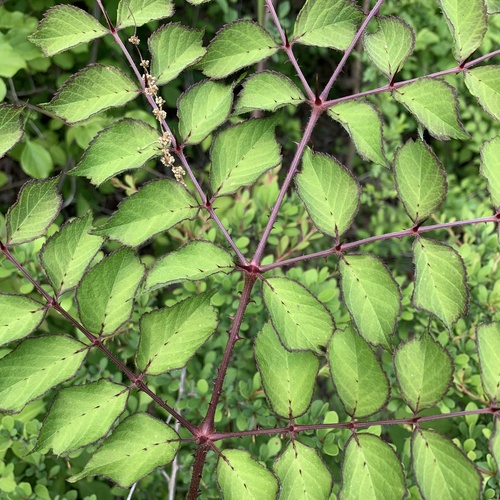
Japanese angelica tree
Aralia elata
A striking architectural tree that transforms from a thorny skeleton in winter to a lush, tropical-looking sanctuary in summer. It is a premier 'wildlife restaurant' for late-season pollinators and migrating birds.
Quick Identification
Size
Typically 6–10 m (20–33 ft) tall; leaves can reach 60–120 cm (2–4 ft) in length.
Colors
Bright green foliage turning yellow to reddish-purple in autumn; creamy white flowers; dark purple-black berries; grey-brown bark.
Key Features
- Massive bi-pinnate or tri-pinnate leaves that look tropical
- Sharp, stout thorns covering the trunk and leaf stalks
- Large, umbrella-like clusters of white flowers in late summer
- Clusters of small, dark purple berries in autumn
When You’ll See Them
Geographic range
Where Does the Japanese angelica tree Live?
Native to the temperate regions of Eastern Asia, the Japanese angelica tree is found throughout Japan, Korea, Northeast China, and the Russian Far East. Beyond its native shores, it has become widely naturalized in the Northeastern United States and parts of Europe, where it is often considered an invasive species due to its ability to outcompete native flora. It thrives particularly well in the transition zones where suburban gardens meet wilder woodland fringes.
Basemap © OpenStreetMap contributors
Behavior
The Japanese angelica tree is a vigorous, fast-growing deciduous species known for its architectural form and aggressive spreading habits. In the wild, it often creates dense thickets by sending up suckers from its shallow root system, effectively colonizing forest edges and clearings. Its growth is remarkably rapid during the spring, with its enormous leaves—some of the largest of any temperate tree—unfolding to create a lush, jungle-like canopy.
For wildlife enthusiasts, this tree is a high-value biological hub. It blooms in late summer (July to August), a time when few other woody plants are flowering, making it a critical nectar source for honeybees, bumblebees, and various butterfly species. As the flowers fade, they give way to heavy clusters of berries that serve as an essential high-energy food source for migrating songbirds in the fall. While humans appreciate the young edible shoots in traditional Asian cuisine, the tree's sharp thorns serve as a natural defense against larger herbivores.
EverydayEarth exclusive
Camera Tips
Capturing the Japanese angelica tree on camera is best approached by focusing on the wildlife it attracts. During the late summer bloom, mount your camera on a tripod or a nearby branch at roughly 5 to 7 feet high, angled toward the large white flower umbels. Because these flowers are a magnet for pollinators, using a high frame rate or 'burst mode' will help you capture clear images of fast-moving swallowtail butterflies and hoverflies against the white backdrop.
As the berries ripen in September and October, the tree becomes a 'hotspot' for bird photography. Place your camera 10-15 feet away from a berry-laden branch. Species like Gray Catbirds, Northern Cardinals, and Cedar Waxwings are frequent visitors. A trail camera with a fast trigger speed is essential here, as birds often dart in for a single berry and fly off quickly. If your camera has a 'time-lapse' setting, try focusing it on a single leaf bud in early May to record the spectacular, rapid expansion of its massive foliage.
Don't ignore the trunk during the winter months. The stark, thorny bark provides excellent texture and can be a great place to spot climbing insects or squirrels. Position the camera low to the ground, facing up the trunk, to capture the dramatic 'Devil's Walking Stick' appearance of the stems. Ensure your camera is set to a wide-angle view if you want to capture the full architectural scale of the tree, as its crown can be surprisingly broad.
Similar Species
Species that look similar or are commonly confused with Japanese angelica tree.
Frequently Asked Questions
Record Japanese angelica tree at your habitat
Connect a camera to start building your own species record — AI identifies every visitor automatically.