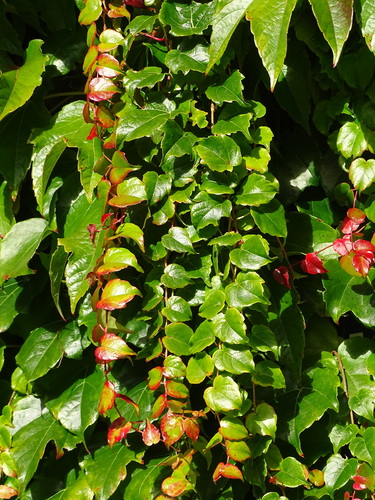
Japanese creeper
Parthenocissus tricuspidata
Transforming ordinary walls into living tapestries, the Japanese creeper is a seasonal showstopper that offers a haven for backyard birds and a fiery display of autumn color.
Quick Identification
Size
A vigorous climber reaching heights of 60–100 feet (18–30 meters); leaves typically measure 2–8 inches (5–20 cm) across.
Colors
Glossy bright green in spring and summer; shifts to spectacular shades of scarlet, orange, and bronze in autumn; dark navy-blue berries on pinkish-red stalks.
Key Features
- Three-lobed leaves with serrated margins
- Branched tendrils equipped with small adhesive suction disks
- Woody vine stems that cling closely to surfaces
- Inconspicuous greenish flowers followed by clusters of dark blue berries
When You’ll See Them
Behavior
Japanese creeper is a master of vertical colonization. Unlike vines that use twining stems or sharp thorns to climb, this species utilizes specialized tendrils tipped with adhesive pads. these 'suckers' allow the plant to scale flat, smooth surfaces like brick, stone, and glass without the need for a trellis. It is a deciduous species, meaning it sheds its leaves in winter, but its dense, overlapping leaf structure creates a 'shingle' effect in summer that can keep buildings remarkably cool.
While it is often confused with invasive ivies, the Japanese creeper is generally less destructive to masonry because its adhesive pads do not penetrate the mortar. In its native habitat and in backyard settings, it acts as a vital vertical ecosystem, providing nesting sites for small birds and a high-energy food source through its berries during the late summer and autumn months.
EverydayEarth exclusive
Camera Tips
Capturing the Japanese creeper is a lesson in patience and time-lapse photography. To truly showcase its 'behavior,' set your camera to take a still image once every hour during daylight for several months. This reveals the fascinating way the leaves track the sun and the incredible speed at which the tendrils find and grip new surfaces. If you are looking for action, focus your camera on the berry clusters in late August and September. These are a magnet for cedar waxwings, robins, and starlings, which will hover or perch precariously to pluck the blue fruit.
For the best visual results, mount your camera at a 45-degree angle to the wall the creeper is climbing. This provides depth and highlights the texture of the leaves and the woody structure of the vines. If your camera has a 'motion trigger,' be aware that wind can cause frequent false alerts due to the fluttering leaves. Adjust your sensitivity settings to 'Medium' or focus the motion zone on a specific area where the berries are concentrated to capture visiting wildlife rather than every breeze.
The 'Golden Hour' (shortly before sunset) is the best time for color accuracy. The low sun highlights the glossy sheen of the leaves and makes the red autumn pigments pop. If you are using an AI-powered camera like those from EverydayEarth, you can use the foliage as a backdrop to attract and identify various insects. Many species of pollinators and predatory insects like praying mantises use the dense leaf cover for hunting and shelter, providing a wealth of micro-wildlife footage if you use a close-up or macro lens setting.
Similar Species
Species that look similar or are commonly confused with Japanese creeper.
Frequently Asked Questions
Record Japanese creeper at your habitat
Connect a camera to start building your own species record — AI identifies every visitor automatically.