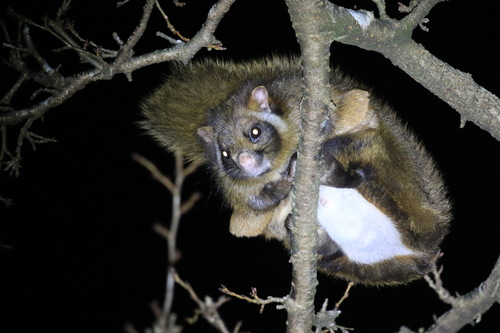
Japanese Giant Flying Squirrel
Petaurista leucogenys
Meet the 'Musasabi,' Japan's charismatic nocturnal glider that turns the forest canopy into a high-altitude playground. With their massive tails and impressive gliding membranes, these gentle giants are the true acrobats of the Japanese night.
Quick Identification
Size
Body length 25–50 cm (10–20 in), tail 30–40 cm (12–16 in), weight 700–1,500 g (1.5–3.3 lb)
Colors
Rufous-brown to dark brown upperparts, creamy white underbelly, and distinctive white patches on the cheeks and throat.
Key Features
- Large furry membrane (patagium) extending from wrists to ankles
- Long, thick cylindrical tail used as a rudder
- Prominent white patches on the sides of the face and neck
- Large, dark eyes specialized for nocturnal navigation
When You’ll See Them
Geographic range
Where Does the Japanese Giant Flying Squirrel Live?
The Japanese Giant Flying Squirrel is an endemic treasure of the Japanese archipelago, found naturally across the islands of Honshu, Shikoku, and Kyushu. It thrives in diverse environments ranging from low-lying coastal forests to high-altitude mountain ranges, often establishing high population densities in the centuries-old trees surrounding rural shrines and temples. While its range is restricted to Japan, it is well-distributed within these regions wherever mature forest canopy remains intact.
Basemap © OpenStreetMap contributors
Behavior
The Japanese Giant Flying Squirrel, known locally as the 'Musasabi,' is a master of the night sky. Unlike birds, they don't fly but glide gracefully using a specialized membrane called a patagium. They are capable of covering distances of over 100 meters in a single leap, steered by their heavy, bushy tails. During the day, they retreat into hollowed-out tree cavities or the eaves of ancient wooden structures, often emerging roughly 30 minutes after sunset to begin their foraging routines.
While they are generally solitary or found in small family groups, they are highly territorial and communicate through a series of loud, high-pitched vocalizations that can be heard echoing through the forest at night. In Japan, they have a unique relationship with humans; they frequently nest in the protected 'sacred groves' surrounding Shinto shrines and Buddhist temples, making them a common sight for those who know where to look. They are rarely aggressive toward humans and are often quite habituated to presence in suburban parks.
EverydayEarth exclusive
Camera Tips
To capture the Musasabi, you must think vertically. These squirrels rarely touch the ground, so placing your camera at eye level will likely result in empty frames. Mount your AI-powered camera 3 to 5 meters (10–16 feet) up the trunk of a large, mature tree—ideally one with visible hollows or near a 'latrine' site (identified by small, rice-grain shaped droppings at the base of the tree). Point the camera toward a nearby trunk that serves as a likely landing platform for a gliding squirrel.
Because they are strictly nocturnal, a camera with high-quality infrared (No-Glow) LEDs is essential. Standard white flashes can startle the animals and disrupt their natural gliding paths. Look for 'commuter trees'—specific trees that squirrels use repeatedly as stepping stones through the canopy. If you find a tree with scratched bark or a clear line of sight to a higher takeoff point, you've found a prime camera location.
Set your camera to a fast trigger speed and use 'Burst Mode' or short video clips (15–20 seconds). These squirrels move surprisingly fast once they land, quickly scurrying to the opposite side of the tree or climbing higher into the canopy. High-sensitivity PIR settings are recommended to detect the heat signature of their bodies against the cooler night air. In winter, they are especially active foraging for pine seeds, so evergreen trees are excellent hotspots during the colder months.
Similar Species
Species that look similar or are commonly confused with Japanese Giant Flying Squirrel.
Frequently Asked Questions
Record Japanese Giant Flying Squirrel at your habitat
Connect a camera to start building your own species record — AI identifies every visitor automatically.