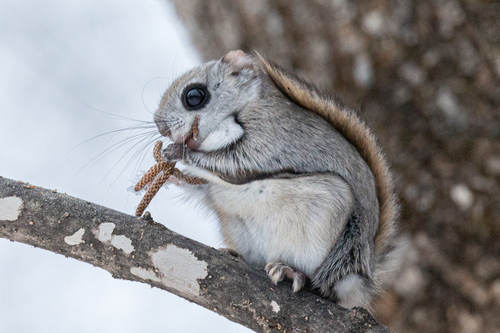
Siberian Flying Squirrel
Pteromys volans
The silver-furred ghost of the northern woods, the Siberian flying squirrel glides silently through the canopy of the Eurasian taiga. Rarely seen but widely beloved, this nocturnal acrobat is a master of the old-growth forest.
Quick Identification
Size
Body length 13–20 cm (5–8 in), tail length 9–14 cm (3.5–5.5 in); weight 95–170 g (3.4–6 oz)
Colors
Soft silver-gray fur on the back, creamy white underparts, and a dark ring around large black eyes
Key Features
- Furry gliding membrane (patagium) between limbs
- Large, dark nocturnal eyes
- Flat, rudder-like tail
- Dense, silky silver-gray fur
When You’ll See Them
Geographic range
Where Does the Siberian Flying Squirrel Live?
The Siberian flying squirrel is a classic resident of the Palearctic region, spanning a massive territory from the Baltic Sea across the vast Russian taiga to the Pacific coast. Its native range includes Finland and Estonia in Europe, stretching eastward through Russia, Mongolia, and Northern China, and reaching as far as the islands of Japan and the Korean Peninsula. In the westernmost parts of its range, it remains a rare and protected specialist of old-growth forests.
Basemap © OpenStreetMap contributors
Behavior
The Siberian flying squirrel is a shy, nocturnal mammal that spent almost its entire life high in the forest canopy. Unlike birds, they do not fly but rather glide gracefully by extending a fold of skin known as a patagium. They are capable of covering distances up to 50 meters in a single leap, using their flat tails as rudders to navigate between trees.
These squirrels are primarily solitary, though they exhibit a unique social behavior during the harsh winter months: several individuals may huddle together in a single tree cavity to share body heat. They are generally non-aggressive toward humans but are incredibly elusive, often remaining motionless or quickly ducking behind a tree trunk when they sense movement or light.
EverydayEarth exclusive
Camera Tips
Capturing the Siberian flying squirrel on camera requires focusing on vertical landscape elements. Look for 'landing trees'—typically large, old-growth conifers or deciduous trees—near suspected nesting sites. You can identify these sites by looking for distinctive orange or yellow droppings that resemble grains of rice at the base of the tree. Mount your camera 3 to 5 meters high on a neighboring trunk, facing the area where you've spotted these signs.
Because these squirrels are strictly nocturnal, your camera's infrared (IR) capabilities are paramount. Use a high-sensitivity setting for the PIR sensor, as these animals are small and fast-moving. A fast trigger speed (under 0.3 seconds) is necessary to catch them as they land or leap, rather than just getting a blur of silver fur. Video mode is highly recommended over still photos, as it allows you to witness the spectacular moment they deploy their gliding membranes.
During the spring and summer, you can attract them to a specific spot by placing a specialized flying squirrel nest box. Aiming your camera at the entrance of such a box is the single most effective way to get clear, close-up footage. Since they are attracted to birch and alder catkins, placing your camera near these trees during the early spring when buds are forming can also yield excellent foraging footage.
Similar Species
Species that look similar or are commonly confused with Siberian Flying Squirrel.
Frequently Asked Questions
Record Siberian Flying Squirrel at your habitat
Connect a camera to start building your own species record — AI identifies every visitor automatically.