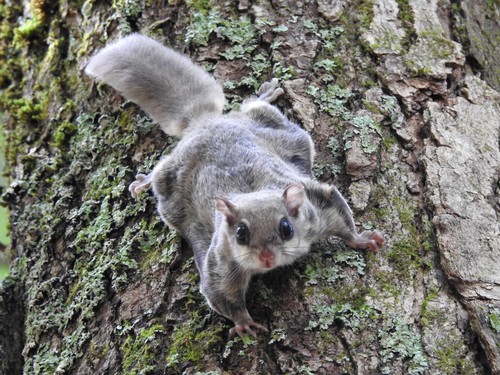
Southern Flying Squirrel
Glaucomys volans
The Southern Flying Squirrel is a wide-eyed, nocturnal acrobat that turns the night sky into a playground. Though they live in neighborhoods across the eastern US, these silent gliders are rarely seen without the help of a specialized camera.
Quick Identification
Size
Length of 8–10 inches (21–26 cm) including the tail; weighs 1.6–4 ounces (46–115 g).
Colors
Soft grayish-brown upper fur with a distinct, creamy-white belly; dark, oversized eyes and a flat, brownish tail.
Key Features
- Furred membrane (patagium) from wrists to ankles
- Large, dark nocturnal eyes for night vision
- Flat, rudder-like tail
- Creamy white belly fur that is white to the base
When You’ll See Them
Geographic range
Where Does the Southern Flying Squirrel Live?
This species is native to the North American continent, primarily occupying the eastern half of the United States and southeastern Canada. Its core range extends from the Great Lakes and New England south to the Gulf of Mexico and Florida. Interestingly, disjunct and isolated populations are also found in the high-altitude mountain forests of Mexico, Guatemala, and Honduras, representing the species' southern limit.
Basemap © OpenStreetMap contributors
Behavior
Southern Flying Squirrels are strictly nocturnal, making them the hidden ghosts of the backyard. Despite their name, they do not fly in the way birds do; instead, they use a specialized membrane called a patagium to glide gracefully from tree to tree. By extending their limbs, they create a sail-like surface that allows them to cover distances of over 150 feet in a single leap, using their flat tail as a rudder to steer and plane for landing.
These squirrels are highly social, especially during the winter months when they form communal nests. It is not uncommon for up to 20 individuals to huddle together in a single tree cavity to share body heat and survive freezing temperatures. While they are shy and rarely seen by humans during the day, they are surprisingly bold at night, often visiting bird feeders in groups and communicating with high-pitched chirps and ultrasonic vocalizations.
EverydayEarth exclusive
Camera Tips
To capture these elusive gliders, camera placement is the most critical factor. Since Southern Flying Squirrels spend very little time on the ground, mount your camera 5 to 8 feet up the trunk of a mature hardwood tree—oaks and hickories are favorites. Angle the camera slightly downward toward a flat branch or a trunk-mounted feeder. Because they are strictly nocturnal, a camera with a high-quality infrared (IR) flash is mandatory. "No-glow" or "black" LEDs are preferable to prevent startling the animals and to ensure you capture natural social behaviors.
Baiting is incredibly effective for this species. Smear a tablespoon of peanut butter or suet directly onto the bark within the camera's focal range. They are also highly attracted to black oil sunflower seeds and whole walnuts. If you have a bird feeder that you suspect is being visited at night, aim your camera there; flying squirrels are frequent "midnight raiders" of suburban bird stations. Their social nature means that once one squirrel finds your bait, you are likely to capture multiple individuals in a single frame.
For the best results, use a fast trigger speed and set your camera to "Burst Mode" or short 15-second video clips. These squirrels move with lightning speed, and a single photo often only catches a tail or a blur. Video is particularly rewarding as it can capture the dramatic moment of landing, where the squirrel flares its patagium to slow down. In winter, activity at bait stations increases as natural food becomes scarce, making the colder months the best time for high-volume captures.
Similar Species
Species that look similar or are commonly confused with Southern Flying Squirrel.
Frequently Asked Questions
Record Southern Flying Squirrel at your habitat
Connect a camera to start building your own species record — AI identifies every visitor automatically.